


.png)



.png)
Somewhere in most B2B SaaS companies there's a document everyone agrees is good. A workshop happened. A deck got built. Maybe the homepage got rewritten. Six or eight months later, marketing is still running four campaigns in four directions, content is publishing on schedule and converting on nothing, sales is describing the product a little differently on every call, and the product roadmap is still mostly a ranked list of whoever asked loudest last quarter.
That gap is the subject of a conversation we had on MAD Talks between Marija Radivojević and Anthony Pierri, co-founder of Fletch PMM, a positioning consultancy that has run more than 500 homepage and positioning sprints for B2B software companies, enough repetitions to notice the same failure pattern across very different businesses.
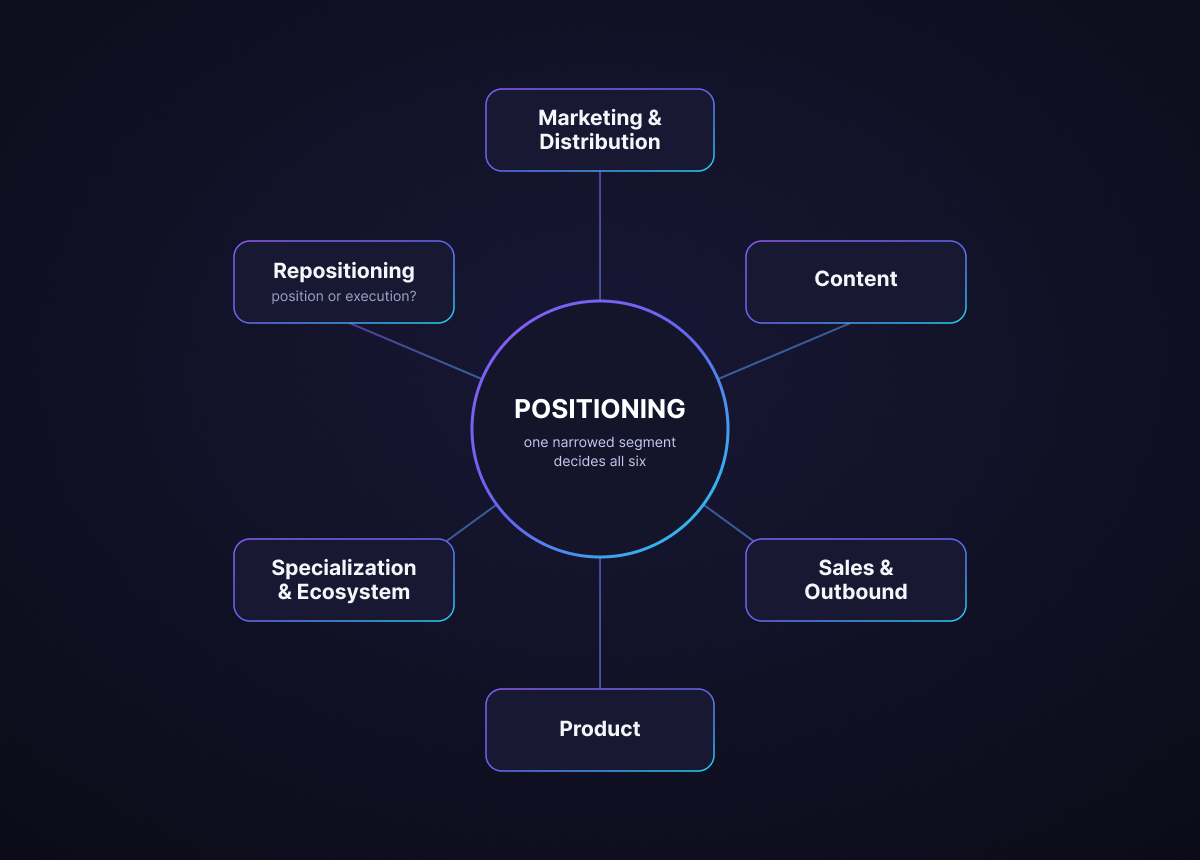
If a company's marketing, content, distribution, sales, product, and partnership decisions look the same as they did before the positioning exercise, that exercise still has work left to do, no matter how good the document reads.
Plenty of these companies get positioning right, on paper. The pattern is what happens after, treating the document as the finish line instead of the starting condition for six decisions that are still waiting to be made.
"Ideal Means One"
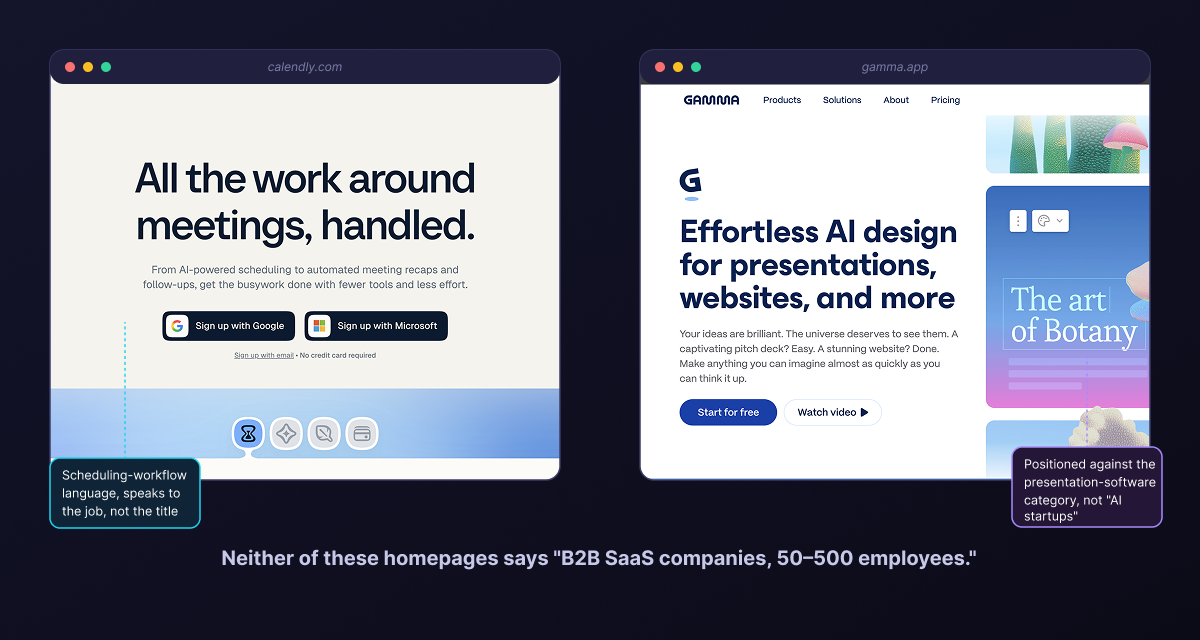
Start with the part almost everyone gets technically right and functionally wrong: the ICP. Ask most B2B SaaS founders who their ideal customer is and you'll get a firmographic answer, company size, funding stage, region, maybe an industry vertical. "B2B SaaS companies, 50 to 500 employees, Series A or B." It sounds specific. It isn't.
Those details are real, but they're not a marketable segment, a list of companies matching five firmographic filters tells you nothing about whether any of them actually need what you sell. Fletch PMM has run more than 500 of these positioning projects, and the list looks almost identical nearly every time.
What makes a segment usable is a layer underneath the firmographics, either a job the buyer is actively trying to get done, or a category they already participate in.
Calendly didn't go looking for "founders." It went looking for people sending scheduling emails back and forth, a specific, recognizable behavior that told you exactly what to say and when to say it. Gamma, the AI presentation company that crossed $100 million in ARR this year, didn't target "startups." Its founder described the target as PowerPoint users, a category-participation signal so precise you already know what the pitch sounds like before you've heard it.
This is where "ideal" stops being a nice word on a slide and starts being a constraint. "Ideal means one," Anthony says. "So you can't have five ideal." Not because other customers can't buy, they can, and often will. But because resourcing, language, and attention have to concentrate somewhere, and a company trying to be equally ideal for four segments ends up being distinctly memorable to none of them.
That distinction, job-to-be-done or category participation, layered on top of firmographics, narrowed to one is the input every decision below depends on. Get it vague, and everything downstream inherits the vagueness.
The resistance to this is almost always emotional before it's strategic. Say "we're for agencies" out loud in a leadership meeting and it sounds like you've just excused every software company, every professional services firm, and everyone else in the market from ever buying. That's not actually what's happening.
Narrowing focus determines where resources and attention are concentrated, not who is excluded. A company that is the clear choice for one group is stronger than one that is vaguely relevant to many. Starting broad and trying to specialize later is much harder.
There's a resourcing dimension underneath the emotional one, too, and it's worth being honest about. How narrow a company needs to go is as much a question of what the team can actually pull off as it is a market decision.
A company with a genuinely massive addressable opportunity and the funding to match doesn't need to narrow as hard; OpenAI's early market was functionally "anyone with a smartphone," and the capital and product breakthrough behind it made that workable. Most companies aren't in that position, and pretending otherwise is how a modest team ends up trying to compete for attention across a market sized for a much better-funded competitor. It's the same reason a strong athlete has a better shot at starting varsity in a hundred-student school than a five-thousand-student one, the goal is to pick a field you can actually win on with the team you have, not to shrink your ambition.
Positioning Decides Where You Show Up Before You Do
Most marketing planning starts backwards. It starts with tactics, we need LinkedIn, we need a podcast, we need to publish more, before anyone has answered the much smaller question of who, specifically, the company is trying to become relevant to. Without that answer, there's no way to know which of those tactics deserves the budget.
A tightly defined segment does something a firmographic list can't: it shrinks the research universe down to something a marketer can actually study. Once you know the exact job or category you're competing in, you can go look at who already owns the attention there, not just the three obvious competitors, but the creators, the niche newsletters, the Reddit communities, the software ecosystems your buyer already lives inside. You can ask why those sources are dominant, which language they've made familiar, and just as usefully where they're weak.
This is also where the channel-selection cliché gets a missing clause. "Pick one channel and stay consistent" is fine advice, but the more useful sentence is: pick the right channel based on the market first. A buyer who spends their day in three specific Slack communities and two industry newsletters is a completely different distribution problem than a buyer who lives on LinkedIn and in a fair number of cases, the best distribution channel is another product, an integration, or a partner ecosystem the buyer already trusts, not a media platform at all.
If your ICP already relies on a complementary tool as part of their existing workflow, getting close to that tool's ecosystem can produce more qualified attention than trying to manufacture interest from nothing.
Why this matters gets clearest with the iPhone. Frame it as a computer, which, technically, it partly is and you're competing in the laptop aisle, arguing you've built a computer that happens to fit in a pocket, against machines that do computer things better. Frame it as a phone, and "smart" becomes the entire differentiation, aimed at every dumb phone already in someone's hand. Same product, but a different set of competitors, a different marketing argument, and different channels for reaching the people already shopping in that aisle.
The positioning decision tells you which battlefield you're standing on before you've written a word of copy.
Narrow the segment, and this stops being a brainstorm. It becomes a research question with an actual answer.
A Content Gap Isn't the Same Thing as a Keyword Gap
Once the channel question is settled, a second, more specific failure shows up, and it's worth being blunt about: the term "content gap" gets used far too casually inside most marketing teams.
A keyword tool telling you a competitor ranks for a term you don't is a data point, not automatically a useful content gap. The useful gap has a seat inside the market position you're actually trying to build and that's a much smaller, much more specific list than a spreadsheet full of search volume.
Take the practical case: your biggest competitor has thousands of backlinks, has been publishing for six years, and already owns every broad category term worth owning. If you're the smaller company, writing your fourth article on that same broad topic isn't a content strategy. It's entering a race the other side started with a six-year lead.
The better move is to go back to the segment, understand its specific use case, its real alternatives, its actual buying journey and ask a narrower set of questions:
- What is this exact buyer searching for while they're evaluating solutions, and which comparison is nobody answering properly?
- Which alternative page is missing, or answered badly?
- Which objection keeps showing up in sales calls but barely exists anywhere in search?
- Which integration does this ICP already rely on every day?
- What does the buyer need to believe, specifically, right before they book a demo?
That's the filter that turns a keyword list into an actual content gap and it points to a distinction worth sitting with: traffic and pipeline are not the same outcome. Broad, top-of-funnel content can look attractive in a spreadsheet full of search volume while doing almost nothing for revenue. Comparison pages, alternative pages, specific solution pages, integration pages, and bottom-of-funnel problem content tend to look worse on that same spreadsheet and do more work, they function as marketing assets, sales assets, and, increasingly, as the material AI answer engines pull from when a buyer asks an assistant for a recommendation instead of typing a query into Google. That's a materially more interesting content system than a monthly count of how many posts got published.
There's a related failure on the org-chart side of this, one that has nothing to do with search: marketing that sits too far from the product. You can't write a convincing comparison page without understanding, specifically, where your product wins and where it doesn't. You can't write a useful solution page if you've never actually heard a buyer describe the problem in their own words. Without enough product depth, content becomes generic by default, polished, on-brand, and interchangeable with every competitor's version of the same page.
The strategic filter above is what decides which gaps are worth chasing in the first place. Actually building the system that wins them, the topical authority and AI-visibility architecture underneath it is its own execution problem, and one covered in more depth in AEO for B2B SaaS and the 12-month marketing roadmap.
What a Sales Signal Is Actually Standing On
Modern sales tooling has gotten very good at telling reps who to call. Intent data, trigger-based outbound, signal-based selling, all useful, and all quietly dependent on a piece of homework most teams skip.
A signal is a proxy. Nobody has direct visibility into what's actually happening behind a prospect's closed doors, what job they're trying to get done, what they're currently limping along with instead. So sales tools substitute a cluster of observable behaviors and treat them as evidence of the thing you can't see directly. That substitution only works if you already know, with some precision, what the underlying job-to-be-done actually is.
Take a simple, sharp example from the conversation: a direct competitor raises its price significantly, for the right kind of company. That's an excellent trigger, but only for a team that already knows which companies are "the right kind," because they've already done the segmentation work above. Without that groundwork, the same price increase is just noise in a dashboard.
This is the sales-side version of the same problem content and marketing have: sophisticated tactics sitting on top of a foundation nobody actually poured. The tooling gets more advanced every year. The requirement underneath it hasn't changed, clear positioning is still the thing that tells you which signals are worth acting on and which are just activity.
A sales team chasing five loosely defined segments will always look busier than one chasing a single, sharply defined job-to-be-done. It just won't close as much.
The cost of skipping that groundwork doesn't show up as a missing feature in the CRM. It shows up as reps working a technically accurate list that converts badly, and a team concluding the tool doesn't work when the actual problem is one layer upstream, the same segment ambiguity that was already making marketing and content harder than they needed to be, and that tends to resurface later as enterprise deals that stall out before the first sales call ever happens.
The Sushi Restaurant That Also Does Laundry
Positioning tends to get filed under marketing by default, which is exactly how it ends up quietly working against product decisions nobody thought to check against it.
The pattern is easy to describe and hard to notice while it's happening: a company becomes excellent at one workflow. Customers love it for that reason specifically. Then, gradually, a stream of individually reasonable feature requests starts arriving and each one, considered alone, sounds like it should ship.
Enough of those decisions compound, and a company can end up technically capable of doing considerably more while being strategically known for considerably less. Expansion and growth aren't automatically the same thing, the gap between them is usually just a company confusing "we could build this" with "we should." Where this gets concrete is in the founder's own blind spot.
Founders tend to know their product almost too well, they know exactly which feature they personally find impressive, often because it took the most work or represents the most recent thinking. Customers carry none of that context. They arrive with one problem and buy for reasons that can be genuinely disconnected from what the founder assumes is the differentiator.
Talking to customers, in this light, works less like collecting testimonials and more like pattern recognition: what do they actually say the product is, and what were they using or limping along with right before they switched.
The examples that make this land are Spotify and Netflix, and they're worth sitting with because they show the same decision going two different ways. Spotify started as a music platform, added podcasts, then added audiobooks. Every step down that path reinforces the same underlying association: Spotify is where you go to listen to things. The expansion strengthens the position because it's still, unmistakably, the same job. Netflix's path is more interesting because it's mixed. Original shows, produced instead of just licensed, still fit the "place you go to watch things" association, a reasonable extension. Mobile phone games, a bet Netflix quietly wound down in 2025 reportedly did not land the same way, because a TV-streaming brand making pocket games asked customers to make a conceptual leap nobody had signed up for.
It's like walking into a sushi restaurant you love and being told the same place also does your laundry. You didn't ask whether your sushi restaurant does laundry, you asked for good sushi.
That you separately have laundry to do doesn't make the sushi restaurant the right business to solve it, and every company chasing an adjacent customer need runs some version of this same risk, usually without noticing, because each individual request still sounds reasonable in isolation.

Best at One Thing Beats Average at Four
The instinct to say yes to every adjacent feature request usually comes from a legitimate place, founders are wired to see opportunity, and early success does make adjacent opportunities more visible. That's also exactly how a company loses the thing that made the first success possible. It's a safer bet, most of the time, to keep pushing on whatever already worked than to assume the same formula transfers to a neighboring problem.
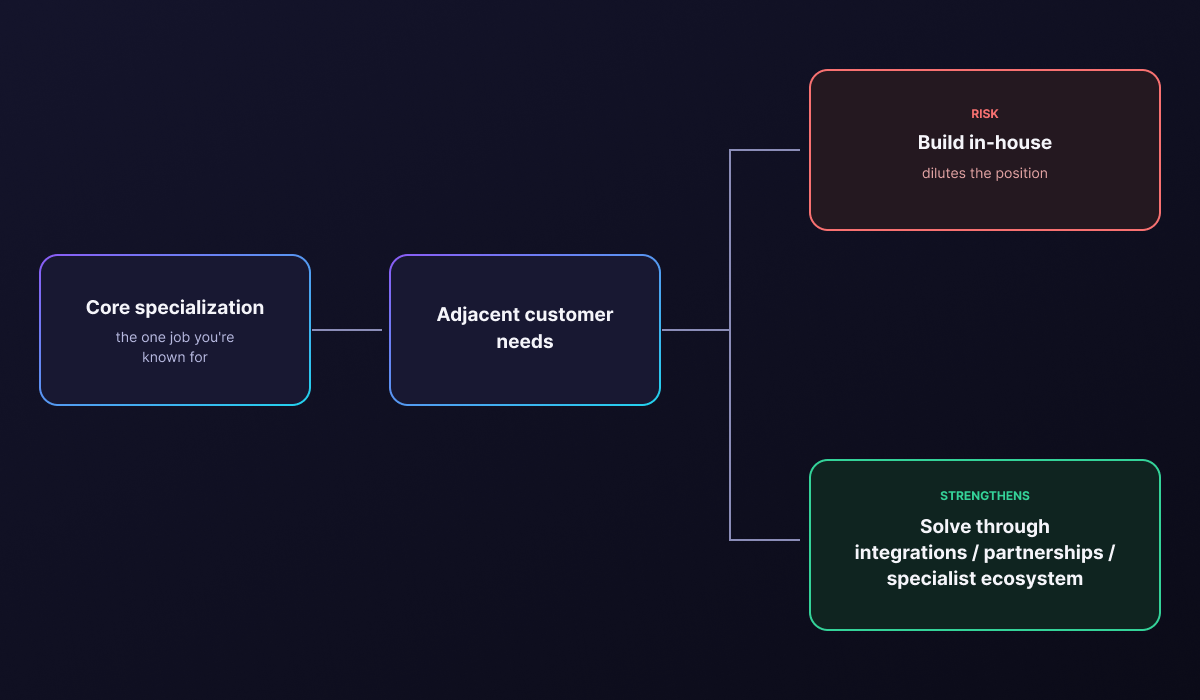
A lot of founders underestimate how much room is actually left in their first market before they've earned the right to worry about a second one. Not expanding the product doesn't mean standing still. The real alternative is getting excellent at one important job and solving everything adjacent to it through integrations, partnerships, or a broader specialist ecosystem, instead of trying to build all of it in-house.
Put simply: it's better to be the best at one thing than average at four. A company that's indispensable for one job and points customers toward trusted partners for the jobs next door usually ends up stronger and more differentiated than one that's quietly mediocre across everything it's added since.
That's the same logic Mad Magnet applies to its own Partner Ecosystem: rather than building out every adjacent capability in-house, the model is to stay excellent at one specific job and route the customer needs next door, legal, finance, development, complementary specialties through specialists who already do that work well. Worth checking against your own roadmap the same way: is the next feature on your list actually strengthening what you're known for, or is it your version of offering laundry?
Is It the Positioning, or Is It the Execution?
Everything above assumes a company has committed to a position and is living inside it. Commitment has a failure mode of its own, though: staying loyal to a position well after it's stopped earning that loyalty.
The useful move here is separating two problems that get treated as one and require completely different fixes, diagnosing which one you actually have before reaching for a redesign. Sometimes the positioning itself is wrong. Sometimes the positioning is actually fine, and the execution around it is inconsistent, which is a different repair entirely.
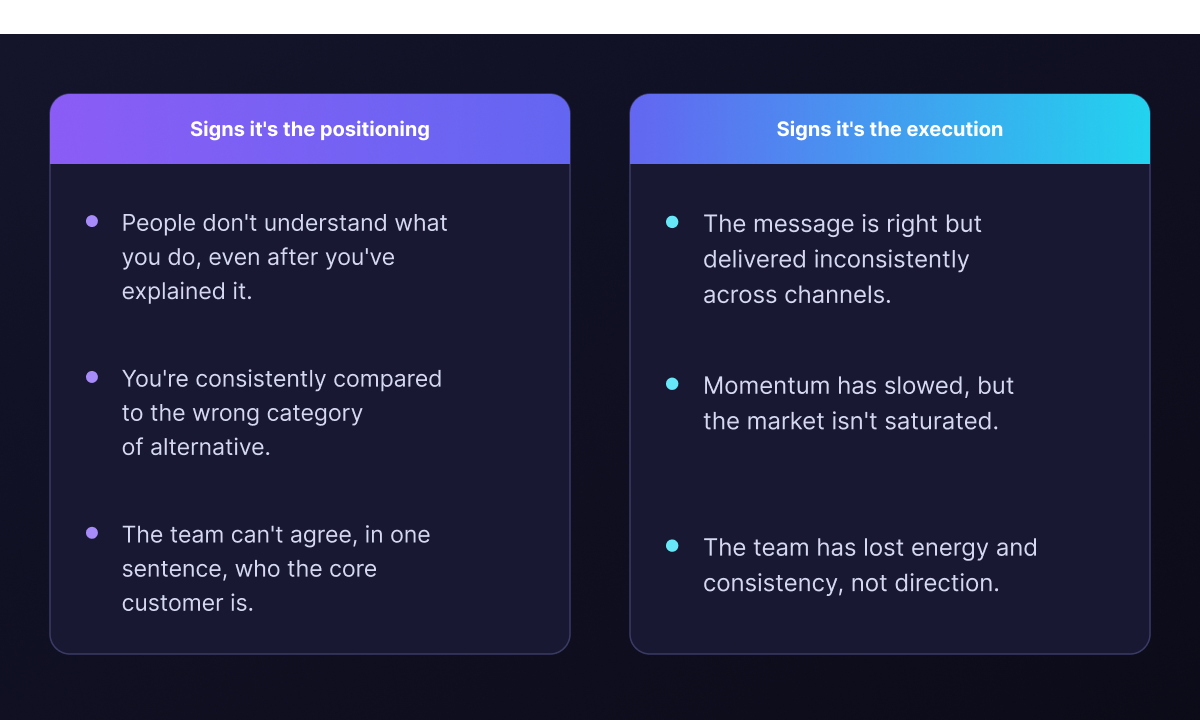
The signals that point toward an actual positioning problem: people consistently don't understand what you do after you've explained it, or they keep comparing you to the wrong category of alternative, no matter how the message gets rephrased.
Internally, the tell is a company that feels like it's being pulled in several directions at once, without a shared, one-sentence answer to who the core customer actually is.
What complicates the diagnosis further is that "we're losing" doesn't automatically mean "we need to reposition." Losing momentum can mean the market's saturated. It can mean you've genuinely reached everyone worth reaching with the current message. More often than either of those, it means the team lost some energy and consistency in how the existing position gets communicated and the honest fix is re-committing to what already worked, not reinventing it.
AI has made this diagnosis noisier than it needs to be. Plenty of companies are currently deciding whether they need an entirely new category, largely because a wave of new products and new terminology has made "sounding new" feel like a requirement. It mostly isn't.
A new category is warranted when something is different enough that people genuinely struggle to file it anywhere familiar, when the reaction is closer to "I don't know what bucket this goes in" than "oh, this is like X, but with AI."
Short of that bar, inventing new language usually just adds a translation step between you and a buyer who already has a mental slot for the thing you're actually offering. The genuine new-category cases exist, eval software, the tooling that checks whether an LLM is doing what it's supposed to, wasn't really a category a few years ago, and now legitimately is. But most SaaS products bolting AI features onto an existing category haven't actually changed what bucket they live in, no matter how many times the homepage insists otherwise.
No one buys or invests in something they don't understand, and reaching for new language is usually the more expensive path to solving a clarity problem that already has a cheaper fix.
Read your own company against these signals honestly, and one of two things becomes clear pretty quickly: either the position needs to change, or the position is fine and something operational underneath it needs attention instead. Those are different projects. Confusing them wastes the kind of time a Series A or B board doesn't hand out twice.
That kind of read is hard to get on your own company, you're too close to the language to hear it the way a buyer does. The Free Positioning Audit exists for that gap specifically: it scans your positioning, ICP alignment, enterprise readiness, and AI visibility, and flags where what you're saying and what a buyer needs to hear have drifted apart, often the exact gap that opens up during the shift from a PLG motion to enterprise sales.
Six Places to Look Before You Touch the Homepage
If you're running this check on your own company, resist starting with the homepage.
Start with the decisions underneath it: what category or job are you actually competing around?
What's the one segment you're prioritizing, not the five you'd like to be relevant to?
What situation sends that buyer looking for a solution, and what are they doing today instead of buying you?
From there, follow it downstream. Does the content plan chase what that buyer is actually stuck on, or whatever a keyword tool happened to surface? Does anyone know which product requests strengthen the position and which quietly work against it? If marketing, sales, and product would each describe the company slightly differently if you asked them separately, that's not six unrelated problems. It's one problem, showing up six times.
Go back to the company at the start of this piece, the one with a document everyone signed off on eight months ago, and nothing downstream that looks different since. Run it through those questions and the diagnosis is rarely mysterious: either nobody made the segment decision the document implies, or they made it and never told marketing, sales, and product to build around it. Both are fixable. Neither gets fixed by rewriting the homepage again.
Get specific enough that the right buyer recognizes themselves without you having to explain it. Then make the whole system built around that one group, product, message, content, sales, distribution, unusually good. Everything else can wait.
Full conversation: MAD Talks — B2B SaaS Positioning Before You Scale Marketing, with Anthony Pierri

Explore more insights
.png)

.png)
The partner that makes your marketing team unstoppable
Completely free. Immediate recommendations.



.svg)


.svg)

.svg)