


.png)



AEO for B2B SaaS: A Complete Framework for Founders in 2026
.png)
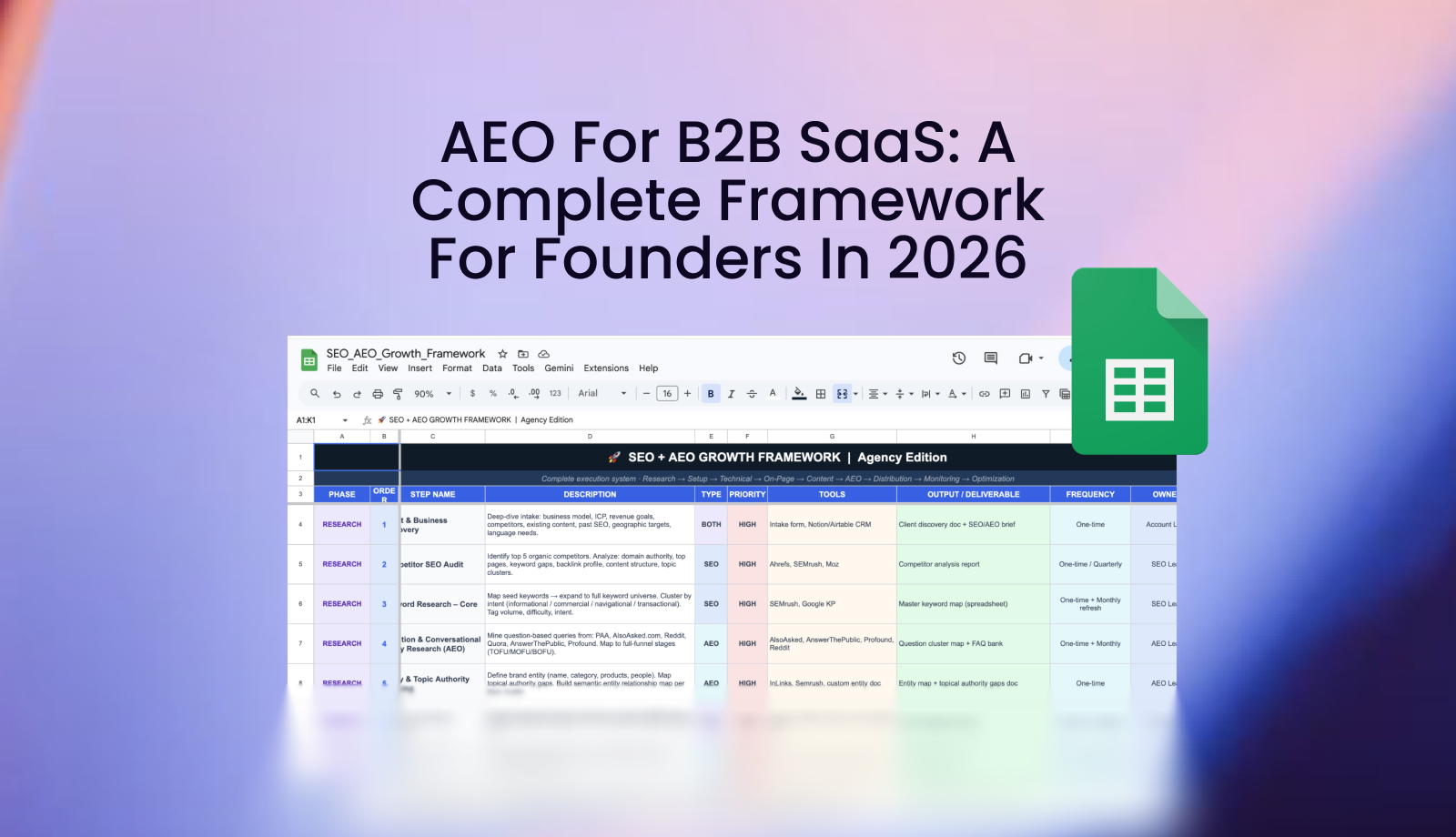
AEO - answer engine optimization - is the practice of structuring content and brand information so that AI systems like ChatGPT and Perplexity cite you when a buyer asks for a recommendation. For B2B SaaS founders, this means your first touchpoint with a buyer increasingly happens before they ever visit your website, inside an AI-generated answer you don't control and may never see. Search Engine Land's research shows a growing share of category research queries now end without a single click to any website, resolved entirely within the AI answer itself.
That matters right now because enterprise buyers have started using AI tools to shortlist vendors before sales ever gets involved. If your brand isn't structured to be cited in those answers, you're not losing to a competitor's better pitch, you're losing before the pitch is ever scheduled, and you won't see it in your funnel data because the buyer never became a lead in the first place.
This guide covers what AEO actually is, how it works, what changes it requires, and what it looks like in practice for a real B2B SaaS company.
What you'll learn
- What AEO means and how it differs from traditional SEO
- How AI answer engines actually decide which brands to cite
- Why enterprise buyers are shifting research behavior toward AI tools
- The four things that make content AI-citable
- What AEO looks like in practice, with a before/after example
- How to check your own current AI visibility this week
Why AEO matters for B2B SaaS specifically
AEO matters more for B2B SaaS than most categories because enterprise buying decisions involve extensive research before any vendor conversation begins, and that research increasingly starts inside an AI tool rather than a search engine results page.
- Buyers ask AI tools comparative questions ("what's the best X for a company our size") that traditional SEO rarely targeted
- AI answers synthesize multiple sources into one response, meaning being on page one of Google no longer guarantees inclusion
- Enterprise procurement teams have started using AI research as an informal first screen before formal vendor outreach
A company ranking first on Google for its category keyword can still be entirely absent from the AI-generated answer to the same question, because the two systems evaluate content differently. This is the same findability problem covered in what procurement committees actually check , AI models and human reviewers are both scanning for structured, extractable proof.
How AI answer engines decide what to cite
AI answer engines don't evaluate content the way a human reader or a traditional search algorithm does. They extract citable claims, specific, structured, verifiable statements, rather than rewarding overall content quality or length.
- Direct-answer content structured for extraction outperforms narrative or story-driven content
- Structured data (schema markup, FAQ formatting) increases the likelihood of citation
- Consistent entity naming across the web (same company description, same category language) reinforces which brand an AI model associates with a topic
This is why a well-written, well-ranked blog post can still be invisible in AI answers, it wasn't structured to be extracted, only to be read.
The shift in enterprise buyer research behavior
Enterprise buyers historically moved from search to vendor website to sales conversation. That sequence is compressing, with AI tools now inserted earlier and doing more of the initial filtering work.
Before: A buyer Googles "best B2B SaaS design agency," reviews five to ten search results, and builds a shortlist manually from website content and reviews.
After: The same buyer asks ChatGPT or Perplexity directly, receives three to five named recommendations synthesized from multiple sources, and only visits the websites of brands that were already named in the answer.
The second buyer never sees a brand absent from that AI answer, regardless of how strong that brand's own website or SEO performance is.
The four content structures that get cited
Content structured for AEO shares four specific characteristics that make it easier for an AI model to extract and cite accurately.
- Direct-answer openings - the core answer stated in the first sentence, not built up to through context
- Definition-plus-use-case formatting - a clear definition immediately followed by a concrete, named example
- Numbered, verb-first steps - process content broken into extractable, sequential units
- Self-contained FAQ blocks - questions and answers that make sense without reading the surrounding article
Content missing all four of these structures can still rank well in traditional search while remaining largely invisible to AI answer engines.
What AEO readiness looks like in practice
A practical AEO audit checks a handful of specific things rather than requiring a full technical overhaul before results are possible. Tools like Profound now track this kind of AI citation performance directly.
- Does the homepage and key service pages include FAQPage schema markup?
- Is your company description consistent across your website, LinkedIn, and directory listings?
- Do your top three category pages open with a direct answer, or with context and scene-setting first?
- Have you tested your own category questions in ChatGPT and Perplexity recently?
Running through these four checks takes under twenty minutes and surfaces most of the highest-impact gaps immediately.
Frequently asked questions
What is AEO (answer engine optimization)?
AEO is the practice of structuring content, schema markup, and brand information so that AI answer engines like ChatGPT and Perplexity cite a company when synthesizing an answer to a relevant buyer question. It differs from SEO in that it optimizes for citation within an AI-generated response rather than ranking position on a search results page.
How is AEO different from SEO?
SEO optimizes for ranking position on a traditional search engine results page, while AEO optimizes for being cited within an AI-generated answer that may never link back to a ranked page at all. The two overlap in areas like technical site health, but AEO adds specific requirements around content structure, schema, and entity consistency that SEO alone doesn't address.
Do I need to choose between SEO and AEO?
No. Most of the technical foundation for SEO - site speed, indexability, structured data - also supports AEO, and the two should be treated as complementary rather than competing priorities.
How do I check if my brand shows up in AI answers?
The fastest way to check is to ask ChatGPT and Perplexity the exact questions your buyers would ask when researching your category, and note whether your brand appears in the response. As of mid-2026, dedicated tracking tools like Profound and Semrush's AI Toolkit also provide ongoing monitoring of AI citation performance.
What is entity consistency and why does it matter for AEO?
Entity consistency refers to using the same company name, description, and category language consistently across your website, LinkedIn, directories, and other public profiles. AI models use this consistency to build confidence about what a brand does and which category it belongs to.
How long does it take to see results from AEO work?
AEO results vary based on existing content volume and technical foundation, but companies starting from a reasonably healthy SEO base typically see initial citation improvements within four to eight weeks of structural content changes.
Does schema markup alone make content AEO-ready?
No. Schema markup is one of four key requirements alongside direct-answer content structure, definition-plus-example formatting, and self-contained FAQ answers, and implementing schema without addressing content structure produces limited improvement on its own.
What does MAD Magnet's AEO work actually include?
MAD Magnet's Marketing Partner engagement includes an AEO audit covering content structure, schema implementation, and entity consistency across a client's public profiles, benchmarked against the specific questions their buyers are actually asking AI tools.
Final thoughts
AEO isn't a future consideration for B2B SaaS founders, it's already shaping which vendors get shortlisted before a single sales conversation happens. The companies structuring their content and brand information for AI citation now are building a compounding advantage that's difficult for competitors to close later. MAD Magnet builds AEO readiness into every Marketing Partner engagement as a core layer, not an afterthought. Run a free positioning and AI-visibility audit to see exactly where your brand currently stands.
Explore more insights
.png)

.png)
The partner that makes your marketing team unstoppable
Completely free. Immediate recommendations.



.svg)


.svg)

.svg)