


.png)



Procurement Checklist: A Framework for SaaS Founders in 2026
.png)
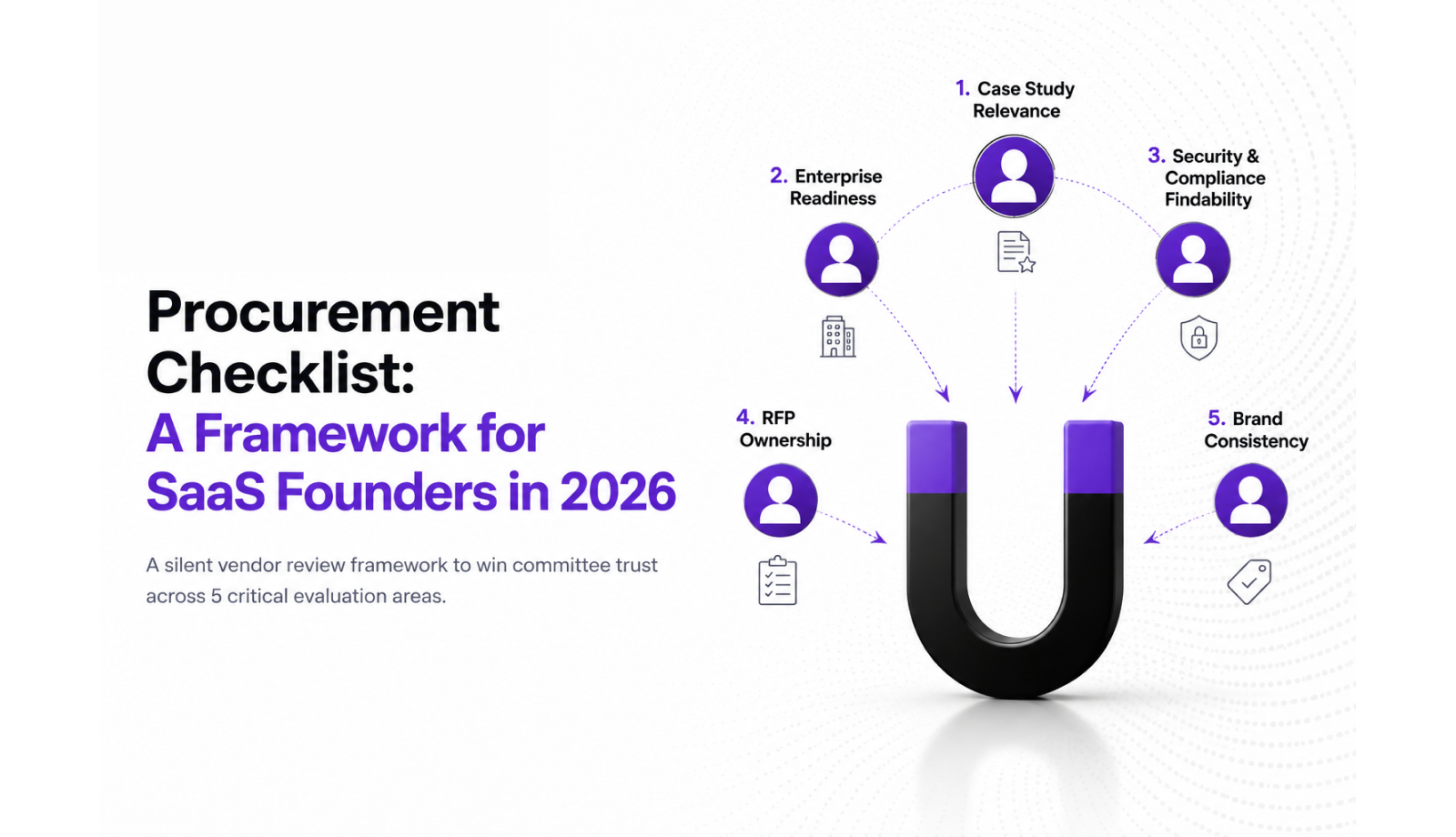
Procurement Checklist: A Framework for SaaS Founders in 2026
Procurement committee evaluation is the stage where most B2B SaaS deals quietly die, not in the demo, and not in negotiation, but in the silent review that happens before anyone tells you the deal has stalled.
For founders, this means a deal you thought was progressing can already be over, and you won't find out for weeks. Gartner's research on B2B buying groups shows that committees now average 6 to 10 stakeholders, each running their own informal checklist before a vendor ever reaches a signature.
That matters right now because most SaaS companies build their brand, website, and sales collateral for a single buyer, not a committee. When a founder assumes "our product is strong enough to carry the deal," they're skipping the exact stage where deals actually stall. The gap between a good product and a closed enterprise deal is almost always a brand and readiness gap, not a product gap.
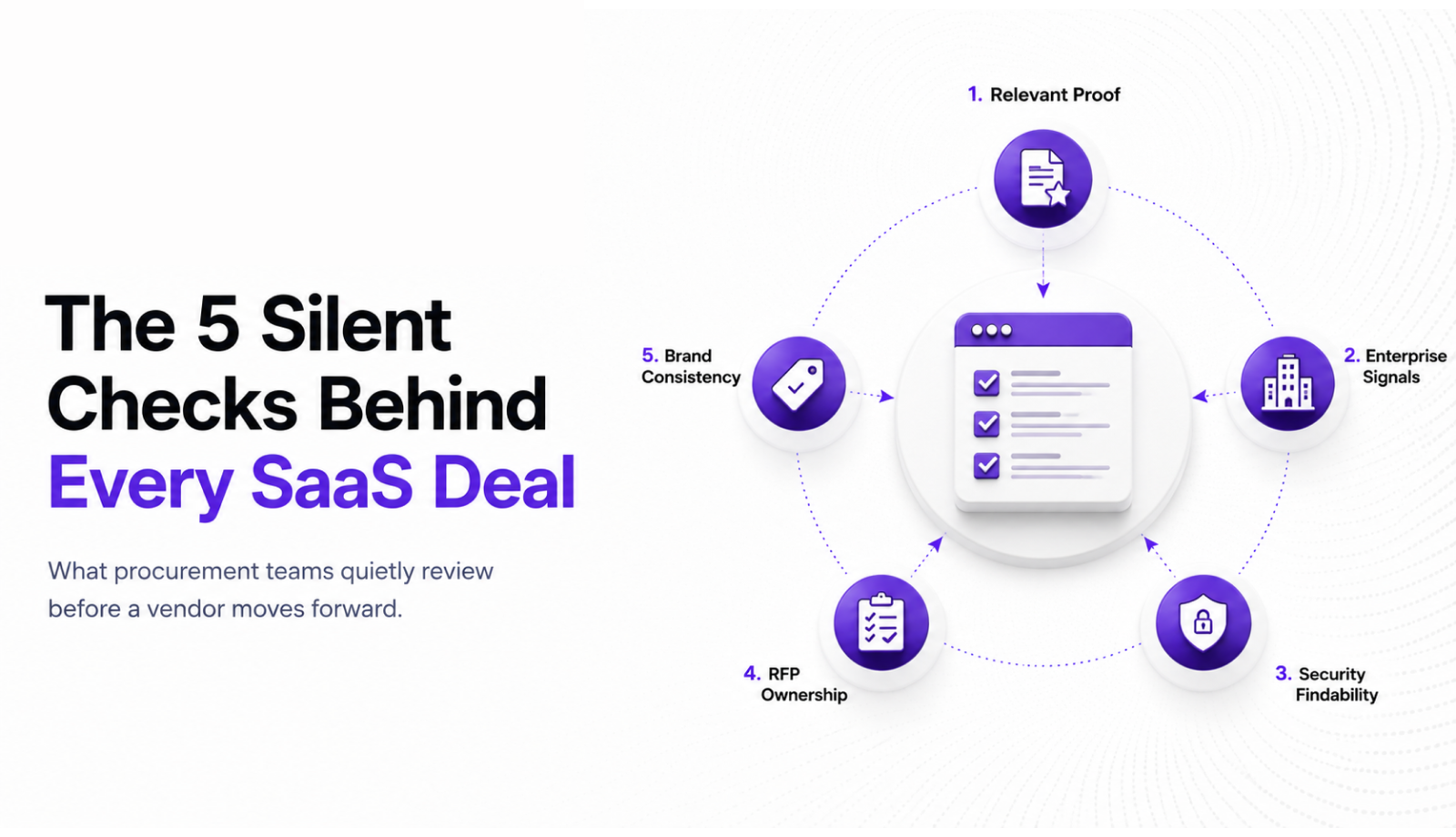
This article breaks down the five things procurement committees actually check before a deal moves forward, in the order they typically check them. By the end, you'll have a working checklist you can run against your own company in about fifteen minutes.
What you'll learn
- Why procurement rejection is silent, not explicit
- The five-point checklist procurement committees run before escalating a deal
- How to tell if your case studies are working against you
- Why security and compliance findability matters more than the answer itself
- Who inside your company should own the RFP response — and why it's often no one
- How to run a fifteen-minute self-audit against this checklist today
Step 1 — Audit whether your case studies match the buyer's size
The first thing a procurement reviewer does is look for proof that companies like theirs have succeeded with you. Case study relevance is not about the number of logos on your page — it's about whether a single one of them resembles the company currently evaluating you.
- Check whether your case studies list company size, industry, or use case
- Check whether any case study features a company within 2x the size of your current prospect
- If none exist, this is flagged internally before the reviewer even reads the content
We worked with an HR tech company whose only public case study featured a 12-person startup. Their pipeline was full of 500+ employee prospects. Once they added a single mid-market case study, discovery-to-proposal conversion improved measurably within one quarter.
Case study relevance alone won't close a deal. But its absence is often enough to quietly end one.
Step 2 — Check whether your website reads self-serve or enterprise-ready
Procurement reviewers scan your site looking for enterprise readiness signals, language, structure, and proof points that suggest you're built for a committee, not just an individual signing up with a credit card.
- "Get started free" language dominating above the fold
- No visible mention of security, compliance, or SLAs
- Pricing that requires a form fill with zero indication of range
Before: "Sign up free — no credit card required" as the primary homepage CTA, with pricing hidden behind a contact form and no mention of SOC 2 or data residency anywhere on the site.
After: A visible "Enterprise" navigation item leading to a page with named compliance certifications, a defined (even if ranged) pricing structure, and language like "built for teams that need governance, not just a login."
A self-serve-first homepage doesn't just fail to help with procurement it actively signals the wrong stage of company to a buying committee.
Step 3 — Confirm compliance and security information is findable, not just true
Having SOC 2 compliance doesn't help if a reviewer has to email your sales rep to confirm it. Findability is the actual requirement here, not just possession of the credential.
- A dedicated security/trust page, linked from the main navigation
- Current compliance certifications listed with dates
- A downloadable security overview document, not just a claim in prose
Procurement reviewers we've spoken with are explicit about this: if they can't find compliance information in under two minutes, they assume it doesn't exist or isn't current. This same findability principle applies to how AI models evaluate your brand, see our guide to AEO for B2B SaaS for the parallel.
Step 4 — Identify who owns your RFP response internally
This is the step most SaaS companies fail before they even realize it's being evaluated. When a prospect sends a security questionnaire or RFP, response ownership determines whether it comes back in two days or two weeks.
- Name a specific owner — not "sales will coordinate," an actual person
- Build a response template library for the 20 most common questions
- Track response time as a metric, not just deal stage
A slow RFP response doesn't just delay a deal. It answers the committee's underlying question, "will this vendor be responsive after we sign?" , before you've had the chance to answer it yourself.
Step 5 — Check for brand consistency across every touchpoint a reviewer sees
Procurement committees don't evaluate you through one channel. They check your website, LinkedIn, G2 reviews, and sales deck — often within the same week. Brand consistency across those touchpoints is a proxy for organizational maturity.
- Does your LinkedIn company page match your website's current positioning?
- Do your sales deck and website make the same core claims?
- Are your G2/Capterra profiles current, or do they describe an old version of the product?
Inconsistency across touchpoints doesn't just look unpolished , it reads as organizational risk to a committee whose job is to minimize exactly that.
What we find in almost every Pilot Program audit
Across more than 20 B2B SaaS brand audits, the same pattern repeats: companies pass 1 or 2 of these five checks and assume that's enough. It isn't. Procurement committees don't average your scores — they flag the first thing that fails and use it to justify moving on to the next vendor. A MAD Magnet Pilot Program runs this exact five-point audit in the first two weeks of engagement, before any brand or marketing work begins, the same diagnosis-first principle applies to every engagement we take on.
Frequently asked questions
What does a B2B SaaS procurement committee actually evaluate?
A procurement committee evaluates vendor case study relevance, enterprise readiness signals on the website, findability of security and compliance information, RFP response speed and ownership, and brand consistency across touchpoints like the website, LinkedIn, and review sites. Most committees run this evaluation informally and silently, without ever telling the vendor which criteria failed.
Why do enterprise deals stall without explanation?
Enterprise deals typically stall because a procurement committee has quietly deprioritized the vendor after failing an internal check, not because of an active rejection. Since this evaluation happens without vendor visibility, founders often don't learn a deal has stalled until weeks after the actual decision was made internally.
How long does a procurement committee evaluation take?
Procurement evaluation timelines vary by company size, but most B2B SaaS committees complete an initial vendor screen within one to two weeks of receiving materials. As of mid-2026, faster-moving enterprise buyers increasingly complete this screening using AI-assisted research tools before ever contacting a sales rep, which compresses the window further.
What is a brand credibility audit?
A brand credibility audit is a structured review of a company's case studies, website positioning, compliance findability, RFP readiness, and cross-channel consistency, designed to identify which of these procurement-facing signals are currently working against the sales team. It is typically the first step in a diagnosis-first engagement, before any design or marketing execution begins.
Should case studies list specific company sizes or industries?
Yes. Case studies that specify company size, industry, or use case allow a procurement reviewer to quickly assess relevance to their own situation. Generic case studies without this context are frequently skipped entirely during committee review, regardless of the results they describe.
Who should own RFP and security questionnaire responses?
A specific named individual should own RFP and security questionnaire responses, supported by a template library covering the most common questions. Diffuse ownership — where responses are handled reactively by whoever is available — is one of the most common reasons response times slip past what procurement committees consider acceptable.
Does website messaging need to change for enterprise buyers?
Yes, in most cases. Messaging built for self-serve, individual buyers rarely reassures a procurement committee evaluating governance, security, and organizational stability, and the two audiences often need distinctly different homepage paths rather than a single blended message.
What happens after a Pilot Program audit identifies these gaps?
After a Pilot Program audit identifies specific gaps, MAD Magnet builds a prioritized roadmap addressing the highest-impact issues first, typically starting with whichever checklist item is actively costing the most active pipeline. Execution then proceeds against that roadmap rather than a generic brand refresh.
Final thoughts
Procurement evaluation is not a wall you clear once, it's a checklist that runs, often silently, on every enterprise deal in your pipeline right now. The five checks above aren't exhaustive, but they cover the majority of what quietly ends deals before a founder ever hears "no." MAD Magnet runs this exact audit as the first step of every Pilot Program, because fixing the wrong layer first is expensive and doesn't move the metric that matters. If you want to know exactly where your own brand fails this checklist, start with a Pilot Program audit.
Explore more insights
.png)

.png)
The partner that makes your marketing team unstoppable
Completely free. Immediate recommendations.



.svg)


.svg)

.svg)