


.png)



What Is AEO and Why B2B SaaS Companies Can't Ignore It in 2026
.png)
AEO — Answer Engine Optimization is the practice of structuring your website so that AI platforms like ChatGPT, Perplexity, and Google AI Overviews cite your brand when your buyers ask questions you should own.
For B2B SaaS companies, this is no longer optional. G2 found that 51% of B2B buyers now start their software vendor research inside an AI chatbot rather than a search engine. If your brand is not cited in those answers, you are not in the consideration set, before your sales team knows the opportunity exists.
This guide explains what AEO is, how it differs from SEO, why it matters specifically for B2B SaaS companies, and the five steps to start getting cited in AI answers today.
What you'll learn
- What AEO is and how it differs from traditional SEO
- Why B2B SaaS enterprise buyers are researching in AI tools before visiting websites
- The data that makes AEO urgent in 2026
- AEO vs SEO vs GEO — the only distinction that matters
- The 5 highest-leverage AEO steps for B2B SaaS websites
- How to measure whether AEO is working
What Is AEO (Answer Engine Optimization)?
AEO is the practice of structuring your website and content so that AI-powered answer engines, ChatGPT, Perplexity, Google AI Overviews, Microsoft Copilot, cite your brand when users ask questions relevant to your product, category, or expertise.
Traditional SEO gets you ranked in a list of blue links. AEO gets you selected as the answer before that list appears.
The mechanics are different. Search engines rank pages based on relevance and authority signals. AI answer engines do not rank pages, they interpret them. They synthesize a response from multiple sources and cite the ones that are most parseable, most authoritative, and most directly answering the question being asked. There is no page two in an AI response. Content is either cited or skipped entirely.
For B2B SaaS companies, this distinction matters enormously. When a CMO or VP of Marketing asks ChatGPT "what is the best [your category] tool for enterprise teams," the AI synthesizes an answer from the sources it trusts most. If your website is not structured to be one of those sources, your brand does not appear, regardless of how good your product is.
Why AEO Is Urgent for B2B SaaS in 2026: The Data
Three numbers make the case for treating AEO as a priority now rather than "something to watch."
94% of B2B buyers now use LLMs during their buying process. According to Forrester's 2026 research, generative AI and conversational search are now the most meaningful source of vendor research — ahead of vendor websites, product experts, and sales reps. The proportion of buyers using AI somewhere in the purchase process has climbed from 89% in 2025 to 94% in 2026.
AI-referred traffic converts 25–80% better than cold organic search. Traffic that arrives via AI assistants tends to be further down the funnel — the model has already done the comparison work, and the visitor is closer to a decision. For B2B SaaS companies, this means AI citations are not just a visibility metric, they are a pipeline metric.
69% of buyers chose a different vendor than they initially planned, based on AI guidance. G2 found that 33% of buyers purchased from a vendor they had never heard of before their ChatGPT conversation. Two-thirds of deals that would have gone to the market's default vendor are now open for re-evaluation in a five-minute AI session. For B2B SaaS companies not yet optimizing for AI visibility, this represents both a risk and a significant opportunity.
AEO vs SEO vs GEO: The Only Distinction That Matters
The industry has not settled on a single term. AEO, GEO, and LLM SEO are often used interchangeably, with slightly different emphasis:
AEO (Answer Engine Optimization) is the broadest term, covering all tactics for being cited in AI-generated answers, featured snippets, voice results, and conversational AI responses.
GEO (Generative Engine Optimization) focuses specifically on synthesized responses from ChatGPT, Perplexity, and Claude, the generative AI layer on top of search.
LLM SEO is the tactical implementation layer, the specific structural and content decisions that make your website parseable and quotable by large language models.
For practical purposes, the implementation across all three is identical. AEO does not replace SEO, it extends it. Strong SEO gets content indexed and discovered. AEO ensures that content is structured to be cited once it is found by AI engines. The companies winning AI visibility in 2026 are building both in parallel, not treating them as alternatives.
For a complete technical implementation system, read our full 9-phase SEO + AEO guide for B2B SaaS websites , including the free 80-step checklist.
Why B2B SaaS Enterprise Buyers Specifically Use AI for Vendor Research
Enterprise buyers have always done extensive research before engaging sales. The research now happens primarily inside AI tools rather than on Google, for a specific reason: AI tools compress the research timeline dramatically.
A CMO evaluating three marketing analytics platforms used to spend hours reading blog posts, comparison pages, and G2 reviews. Now they ask ChatGPT: "What are the best marketing analytics platforms for a Series B B2B SaaS company moving to enterprise?" The AI synthesizes a comparison in 30 seconds.
The consequences for B2B SaaS marketing are significant:
- Buyers are forming a consideration set, and often making preliminary shortlisting decisions — before they visit any vendor website
- Vendors not cited in AI answers are invisible during the highest-influence phase of the buying process
- The content that influences enterprise buyers is no longer just what ranks on Google — it is what AI engines choose to cite and synthesize
- Brand signals that AI engines trust (entity consistency, third-party mentions, structured data, authoritative sources) are different from what traditional SEO rewarded
For B2B SaaS companies in the middle of a PLG-to-enterprise transition, this matters even more. Enterprise buyers expect to find your brand in AI answers. If they search for your category and your brand is absent, the default assumption is that you are not yet enterprise-grade.
The 5 Highest-Leverage AEO Steps for B2B SaaS Websites
These five steps produce the fastest, most measurable AEO impact for B2B SaaS companies starting from zero.
Step 1: Allow AI crawlers in your robots.txt
If AI bots cannot crawl your website, your content is invisible regardless of quality. Update your robots.txt to explicitly allow: GPTBot, OAI-SearchBot (ChatGPT live search retrieval), PerplexityBot, and ClaudeBot. This is a five-minute fix that most B2B SaaS websites have not made.
Step 2: Create an llms.txt file at your domain root
An llms.txt file is a Markdown-formatted plain-text document at yourdomain.com/llms.txt that gives AI models a curated index of your most important pages. Include: pillar pages, service pages, FAQ pages, About page, and any original research. Maximum 100KB, UTF-8 encoded. Think of it as a sitemap written for AI engines rather than Googlebot.
Step 3: Add FAQPage schema to all key pages
FAQPage schema is the single highest-leverage schema type for AEO. Deploy it on every blog post, service page, and key landing page. Write questions exactly as your ICP types them in ChatGPT, not in formal question format. "What is AEO for B2B SaaS?" not "What does Answer Engine Optimization entail for B2B software companies?"
Step 4: Rewrite page intros to lead with the direct answer
44.2% of all LLM citations come from the first 30% of a page's text. If your answer is buried in paragraph four, it will not be cited. Every key page must answer its primary question in the first sentence, no preamble, no context-first, no "in this article we will explore." The answer comes first.
Step 5: Set up AI visibility tracking
You cannot improve what you cannot measure. Set up Profound or Otterly.ai to track brand mentions in ChatGPT, Perplexity, and Google AI Overviews. In GA4, create custom channel groupings to capture AI referral sessions from chat.openai.com, perplexity.ai, and gemini.google.com. This baseline is the starting point for measuring progress.
How to Measure Whether Your AEO Strategy Is Working
Traditional keyword rank tracking does not capture AI visibility. Set up a separate measurement layer from day one.
AI citation rate: Use Profound or Otterly.ai to monitor which of your target queries trigger your brand to appear in ChatGPT, Perplexity, and Google AI Overviews. Track this weekly and benchmark against competitors.
AI referral traffic: In GA4, create custom channel groupings for sessions originating from chat.openai.com, perplexity.ai, gemini.google.com, and bing.com/chat. This traffic will be small initially and grow as AEO implementation compounds.
Traditional signals that correlate with AEO: Google Search Console impressions for question-based queries, featured snippet ownership, and People Also Ask coverage. These traditional SEO signals overlap with AEO because the same content structure that earns featured snippets also earns AI citations.
Pipeline signal: Ask every new inbound lead where they first heard about you. As AEO compounds, "ChatGPT" or "Perplexity" will start appearing in discovery source attribution, months before the GA4 data makes the pattern fully visible.
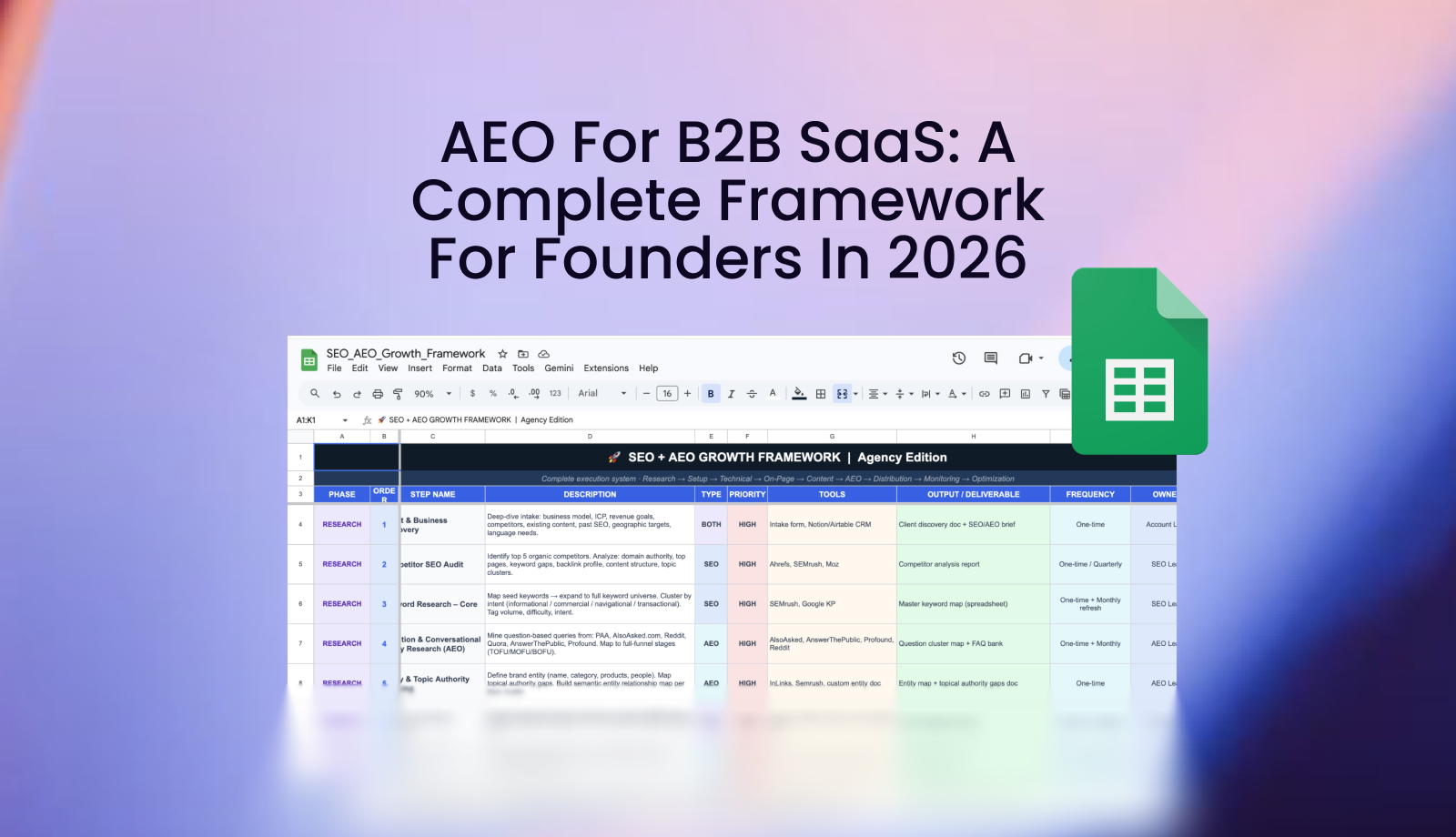
For a complete technical implementation system covering all nine phases of SEO and AEO optimization, including the free 80-step Google Sheet checklist, read our full LLM SEO and AEO guide for B2B SaaS websites.
If you want a team to implement AEO as part of a complete content and SEO system for your B2B SaaS company, our Marketing Partner package covers this as an embedded service. Every engagement starts with a Pilot Program that audits your current AEO baseline before building anything.
Frequently Asked Questions
What is AEO (Answer Engine Optimization)?
AEO (Answer Engine Optimization) is the practice of structuring your website and content so that AI platforms like ChatGPT, Perplexity, Google AI Overviews, and Microsoft Copilot cite your brand when users ask questions relevant to your product or category. Unlike traditional SEO, which gets you ranked in a list of links, AEO gets your brand selected as the answer inside the AI response, before any list appears. For B2B SaaS companies, this matters because 51% of buyers now start their software vendor research inside an AI chatbot rather than a search engine.
What is the difference between AEO and SEO?
SEO optimizes your website to rank in a list of results on Google or Bing. AEO optimizes your website to be cited as the answer inside AI-generated responses from ChatGPT, Perplexity, and Google AI Overviews. AEO builds on SEO fundamentals but rewards different signals: direct-answer intros, FAQ schema, entity consistency, and AI crawler access. AEO does not replace SEO, it extends it into the AI search layer where B2B buyers are increasingly doing their early vendor research.
Does AEO actually drive leads for B2B SaaS companies?
Yes, and the conversion data is compelling. AI-referred traffic converts 25–80% better than cold organic search for most B2B SaaS companies, because AI models have already done the comparison work before sending the visitor to a website. G2 found that 69% of buyers chose a different vendor than they initially planned based on AI chatbot guidance, and 33% bought from a vendor they had never heard of before the conversation.
How is AEO different from GEO and LLM SEO?
AEO, GEO, and LLM SEO all describe the same goal from different angles. AEO is the broadest term covering all tactics for being cited in AI answers. GEO focuses specifically on synthesized responses from ChatGPT, Perplexity, and Claude. LLM SEO is the tactical implementation layer. For practical purposes, the implementation is identical across all three, which is why this guide treats them as one integrated discipline.
How do I know if my B2B SaaS company needs AEO?
Test your most important category queries directly in ChatGPT and Perplexity right now. If your brand does not appear in the answer, and a competitor does you are already losing deals before the first sales conversation. 94% of B2B buyers now use LLMs during their buying process, according to Forrester's 2026 data. If your target buyers are enterprise decision-makers, they are almost certainly researching in AI tools today.
What are the first steps to start with AEO for my SaaS website?
The five highest-leverage AEO starting points: update robots.txt to allow GPTBot, OAI-SearchBot, PerplexityBot, and ClaudeBot; create an llms.txt file at your domain root; add FAQPage schema to all key pages with questions written as your ICP types them in ChatGPT; rewrite page intros to lead with the direct answer in the first sentence; and set up Profound or Otterly.ai to track when your brand starts appearing in AI answers. For the complete 9-phase implementation system, read our full SEO + AEO guide.
.png)
Explore more insights
.png)

.png)
The partner that makes your marketing team unstoppable
Completely free. Immediate recommendations.



.svg)


.svg)

.svg)