


.png)



How to Get Cited in ChatGPT and Google AI in 2026
.png)
Your enterprise buyers are no longer starting their vendor research on Google. They open ChatGPT or Perplexity, type a question about their problem, and shortlist the companies that appear in the answer. If your B2B SaaS brand is not cited there, you are invisible before the first sales conversation begins.
AEO (Answer Engine Optimization) is the practice of structuring your website so that AI platforms like ChatGPT, Perplexity, Google AI Overviews, and Microsoft Copilot cite your brand when your ICP asks questions you should own. Traditional SEO gets you ranked in a list. AEO gets you selected as the answer before that list appears.
The numbers make this urgent: 93% of AI search sessions end without a website click yet brands cited inside AI answers earn 35% more organic clicks than those that are not. AI crawlers now crawl 3.6x more pages than Googlebot. Most B2B SaaS websites are not structured for any of this.
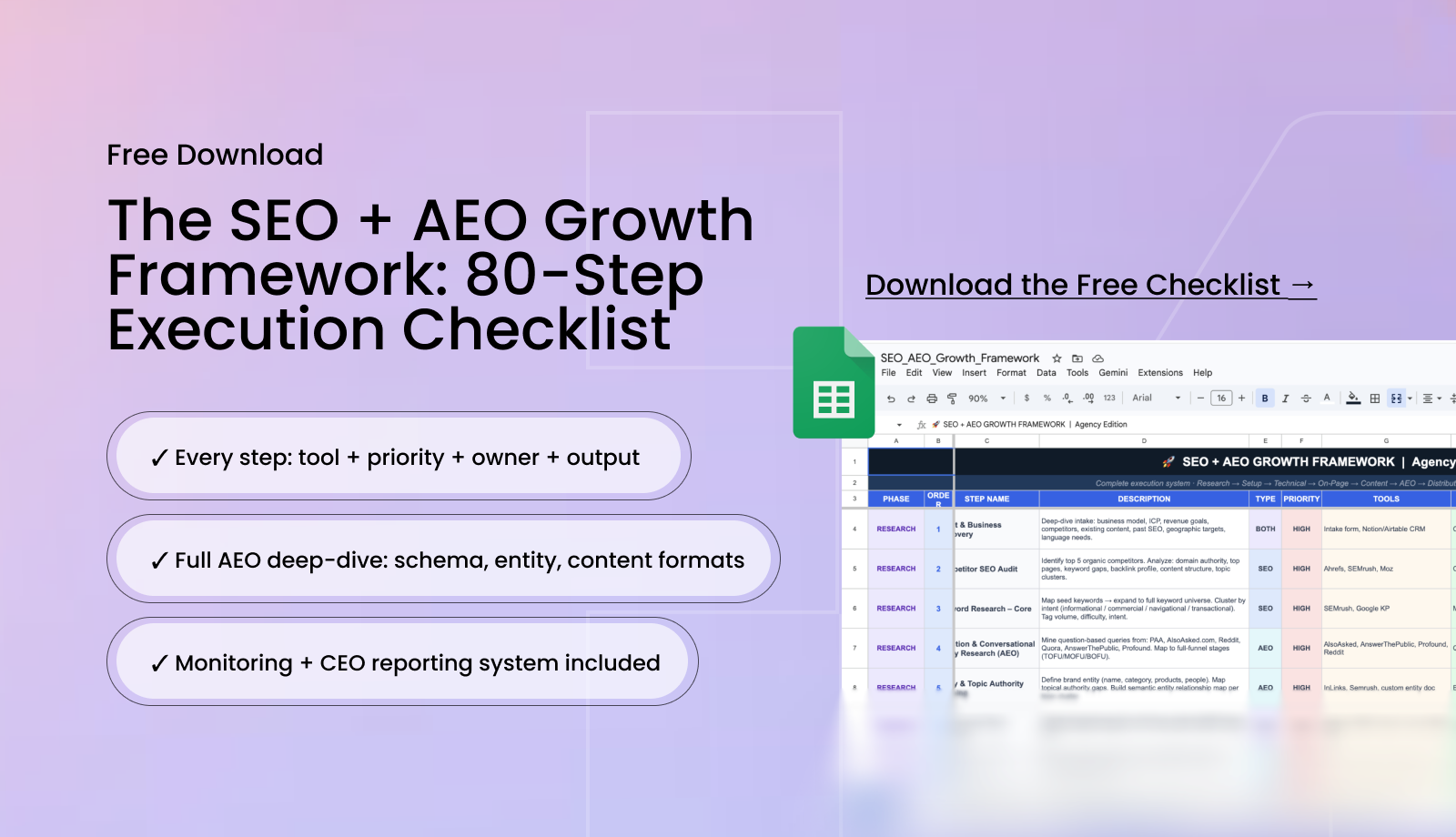
This guide gives you the complete 9-phase execution system, and a free 80-step checklist you can download and run on your own website today.
What you'll learn
1. Why B2B SaaS enterprise buyers are now shortlisting vendors in ChatGPT before visiting your website
2. The 3 filters AI engines use to decide what to cite and how to pass all three
3. The complete 9-phase SEO + AEO system, from technical setup to AI citation tracking
4. Which schema types produce the most AI citations for B2B SaaS websites
5. How to track AI visibility in GA4, Profound, and Otterly.ai
6. The free 80-step checklist you can download and run on your website today
The Three Filters AI Engines Use Before Citing Any Page
Before building any of the nine phases, understand how AI engines select what to cite. Every page passes through three sequential filters:
Filter 1: Can AI crawl and read this page?
If your robots.txt blocks AI bots, your content renders only in JavaScript, or your page loads too slowly the page is invisible regardless of quality. This is the technical layer. The bots to allow: GPTBot, OAI-SearchBot, PerplexityBot, ClaudeBot.
Filter 2: Does this page directly answer the question being asked?
44.2% of all LLM citations come from the first 30% of a page's text. If your answer is buried below three paragraphs of context, it will not be cited. The answer must come first.
Filter 3: Is this source trusted enough to cite?
Branded web mentions have a 0.664 correlation with AI Overview appearances, significantly higher than backlinks at 0.218. Authority in AI search is built through brand mentions across trusted third-party sources, not just link count.
Every phase below maps to one of these three filters.
The 9-Phase SEO + AEO System for B2B SaaS
Phase 1 — Research: Map What Your ICP Actually Asks in AI Tools
Before any technical or content work begins, you need to know exactly which questions your ICP types into ChatGPT, Perplexity, and Google when they have the problem your product solves.
Mine question-based queries from: People Also Ask, AlsoAsked.com, Reddit, and Profound. Test your target queries directly in ChatGPT and Perplexity right now. Who appears? In what format? What gaps exist?
Map questions to funnel stages: TOFU (what is / how does), MOFU (X vs Y / best X for this use case), BOFU (how to get started / pricing / how to evaluate). Build a question cluster map and FAQ bank. This becomes the foundation for all content in Phase 5.
Run a competitor SEO audit in Ahrefs or Semrush. Identify which questions your competitors own and where gaps exist that you can fill with better, more specific answers.
Phase 2 — Setup: Allow AI Crawlers and Create Your llms.txt File
This is the highest-leverage technical setup most B2B SaaS websites skip entirely.
robots.txt update: Explicitly allow GPTBot, OAI-SearchBot (ChatGPT live search), PerplexityBot, and ClaudeBot for all indexed content. Note: GPTBot and Google-Extended control training data collection and can be managed separately from live search retrieval.
llms.txt file: Create a Markdown-formatted plain-text document at yourdomain.com/llms.txt. Think of it as a sitemap written for AI engines rather than Googlebot. Include: pillar pages, service pages, FAQ pages, About page, and original research. Maximum 100KB, UTF-8 encoded. Update quarterly.
Brand entity documentation: Write a consistent brand entity block, company name, category, products, founders, mission. Deploy this exact language on your About page, in Organization schema, on LinkedIn, and on any directory where your brand appears. Consistency across sources builds entity trust with AI engines.
Analytics setup: Install GA4, Google Search Console, and Google Tag Manager. Create custom GA4 channel groupings to capture AI referral traffic from chat.openai.com, perplexity.ai, and gemini.google.com. Set up Profound or Otterly.ai for AI mention monitoring. You cannot improve what you cannot measure.
Phase 3 — Technical Foundation: Fix What Blocks Crawling and Indexation
Technical issues prevent even perfectly written content from being cited. Resolve these before investing in content.
Core Web Vitals: Run Google PageSpeed Insights on all key pages. Compress images to WebP or AVIF under 200KB. Defer non-critical JavaScript. Target all Core Web Vitals in the green range. Check monthly.
Crawlability audit: Crawl the full site with Screaming Frog. Fix broken links, redirect chains, and orphan pages. Verify no key pages are excluded in Google Search Console Coverage report.
JavaScript SEO: Ensure all critical content, headings, body text, FAQ answers, is server-side rendered, not JavaScript-only. AI crawlers often cannot execute JavaScript and will miss content that only renders in the browser.
Internal link architecture: Pillar pages must receive the highest volume of internal links from cluster articles. Anchor text must be descriptive and keyword-relevant. Never "click here" or "read more."
Phase 4 — On-Page Optimisation: Signal Topic Clearly to Both Humans and AI
Every key page must pass an on-page checklist before content investment begins.
- Meta title: 50–60 characters, primary keyword first, brand suffix. Different from the H1.
- Meta description: 150–160 characters, answer-oriented, includes a soft CTA. This is marketing copy it sells the click and signals content scope to AI engines.
- H1–H6 hierarchy: One H1 per page containing the primary keyword. H2 for main sections. H3 for subsections. No skipped heading levels.
- Semantic HTML: Use HTML5 semantic elements —
<article>,<section>,<header>,<main>. AI engines use semantic structure to understand content hierarchy. - Image alt text: Descriptive, under 125 characters, contextually relevant to surrounding content.
- Open Graph tags: OG title, description, and image (1200×630px) on all pages.
- Breadcrumbs: Deploy site-wide with BreadcrumbList schema.
Phase 5 — Content Architecture: Build Topical Authority with Pillar-Cluster Structure
AI engines identify topical authority by looking at whether your website comprehensively covers a subject area, not just whether individual pages mention the right keywords.
Pillar pages: One per core topic cluster. 2,000–3,000 words. Comprehensive coverage of the topic. Links to all cluster articles. At least one BOFU CTA. Structured with direct-answer openings and FAQ sections. For B2B SaaS companies, pillar topics should map directly to the questions your ICP asks when evaluating vendors, not just to product features.
Cluster articles: 1,000–1,800 words each. Every cluster article links back to its pillar. Mapped to a funnel stage and to a specific question from your question bank. This is the monthly content engine.
AEO writing format — non-negotiable for every piece:
- Direct-answer intro: Answer the primary question in the first sentence. No preamble, no context-first. The answer comes before the background.
- Definition + use case: For any concept: what is X (2–3 sentences) → immediately followed by a real-world use case. AI engines extract these independently of surrounding content.
- Step-by-step H3 structure: For process content: numbered H3 steps, each self-contained and answerable without reading the full article.
- FAQ section: Minimum 5 questions per key page. Written as your ICP actually types them in ChatGPT, not in formal question format.
- Comparison tables: Explicit comparison tables for any X vs Y or X for Y query. AI engines prefer structured, extractable comparisons.
For B2B SaaS companies without a full in-house content team, read our guide on when an embedded agency makes more sense than building content in-house.
Phase 6 — Schema Markup: The Technical Layer That Unlocks AI Citation
Schema markup is the single highest-leverage technical AEO action for most B2B SaaS websites. It tells AI engines exactly what type of content a page contains and how to extract it.
Priority schema types for B2B SaaS:
- FAQPage: Deploy on every blog post, service page, and key landing page. Minimum 5 Q&A pairs per page. Questions written as your ICP types them.
- Article: On all blog posts. Include
datePublished,dateModified,author, andpublisher. - HowTo: On all process and step-by-step content. Each step must be self-contained.
- Organization: On homepage and About page. Include name, URL, logo, social profiles, and founding date.
- BreadcrumbList: Site-wide on all pages.
- SoftwareApplication: On product and feature pages. Include operating system, application category, and offer details.
Validate all schema with Schema.org Validator and Google's Rich Results Test before publishing.
Phase 7 — Authority Building: The Signals AI Engines Trust Most
Branded web mentions correlate more strongly with AI Overview appearances than backlinks. This changes the authority-building strategy for B2B SaaS companies significantly.
Priority authority signals:
- G2, Capterra, and category directories: Consistent brand mentions on software review platforms build the entity trust AI engines need to confidently cite your brand.
- Guest content on industry publications: Articles on recognized B2B SaaS publications create external citations that AI engines treat as trust signals.
- HARO and Qwoted responses: Getting quoted in press articles creates exactly the type of branded web mention that correlates with AI visibility.
- Consistent NAP across directories: Your company name, URL, and description should be identical across every platform where your brand appears.
Phase 8 — Local and Entity Signals (If Relevant)
For B2B SaaS companies with a regional focus or physical presence, Google Business Profile is a high-priority AEO signal, AI engines use GBP data to build location-specific entity knowledge.
If your company is eligible, seed a Wikipedia or Wikidata entry. Consistent brand entity information across Wikipedia, Crunchbase, LinkedIn, and your own About page significantly increases AI engine confidence in citing your brand accurately.
Phase 9 — Tracking and Reporting: Measure AI Visibility, Not Just Google Rankings
Traditional rank tracking does not capture AI visibility. Set up a separate measurement layer.
AI visibility tracking: Use Profound or Otterly.ai to monitor brand mentions in ChatGPT, Perplexity, and Google AI Overviews. Track which queries trigger citations and which competitors appear instead.
AI referral traffic: In GA4, create custom channel groupings to capture sessions from chat.openai.com, perplexity.ai, and gemini.google.com. This traffic will grow as AEO work compounds.
Traditional SEO signals: Google Search Console impressions and clicks for FAQ and featured snippet queries. Target queries where AI Overviews are triggered, these are the highest-value optimization opportunities.
Monthly review cadence: AI citation rate for target queries → AI referral traffic → GSC impressions for question-based queries → Featured snippet ownership → Core Web Vitals status.
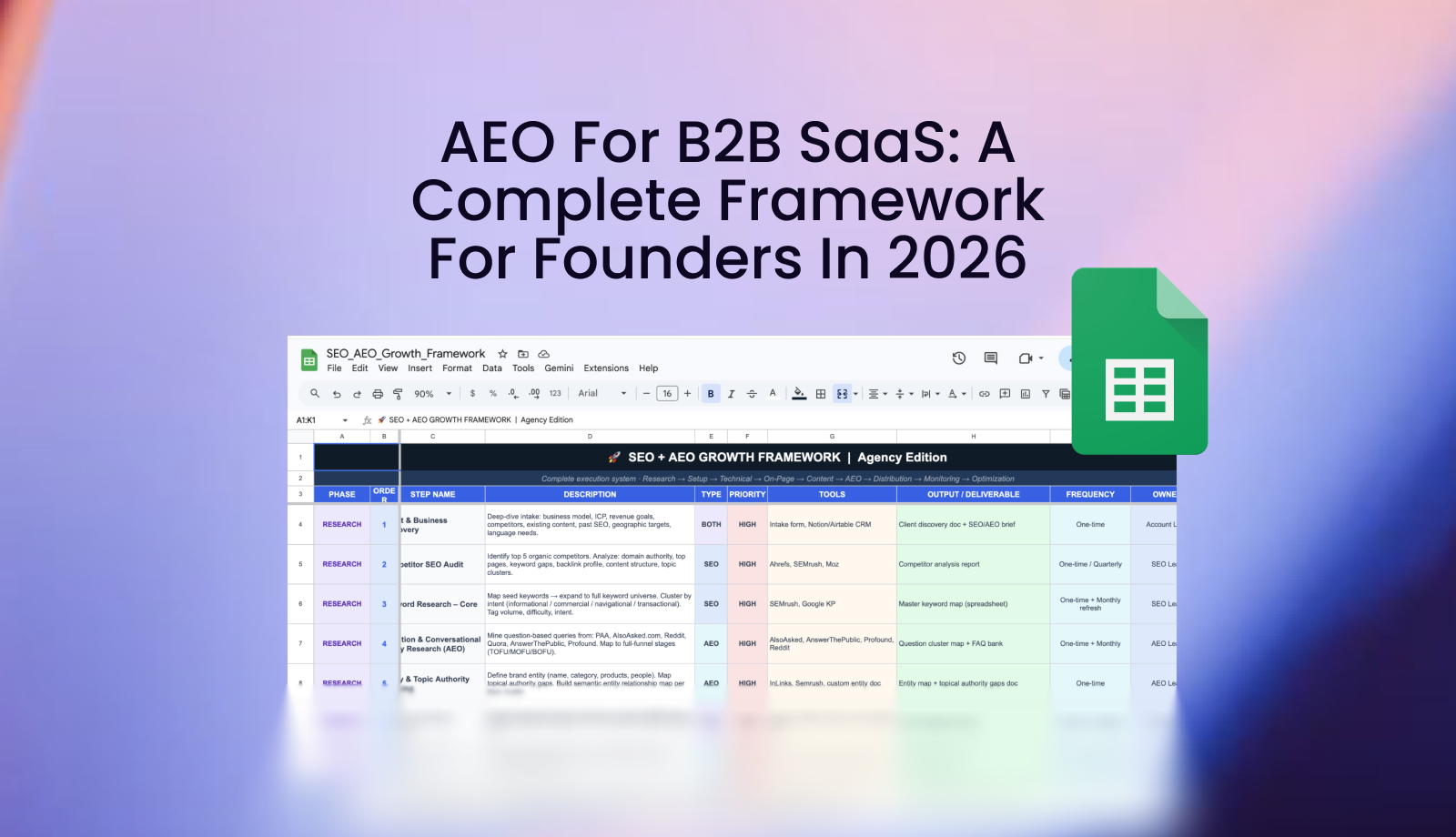
Every phase in this guide maps to a specific row in our SEO + AEO Framework, the same Google Sheet we use with every B2B SaaS client we work with. It includes: all 80 steps across all 9 phases, the right tool for each step, priority level, output format, and frequency (one-time vs monthly vs quarterly).
If you want a team to implement this system for your B2B SaaS company rather than running it internally, our Marketing Partner package covers SEO, AEO, content architecture, and schema implementation as a complete embedded service. Every engagement starts with a Pilot Program that audits your current SEO and AEO baseline before we build anything.
Frequently Asked Questions
How do I get my B2B SaaS website to show up in ChatGPT answers?
To appear in ChatGPT answers, your website needs three things: AI bots must be able to crawl it (allow GPTBot, OAI-SearchBot, PerplexityBot, ClaudeBot in your robots.txt), your content must answer questions directly in the first paragraph (not buried below the fold), and your brand must have sufficient authority signals, branded web mentions correlate 0.664 with AI Overview appearances. The fastest practical steps are: create an llms.txt file at your domain root, add FAQPage schema to all key pages, rewrite page intros to lead with the answer, and set up Profound to track when you start appearing.
What is the difference between SEO and AEO for B2B SaaS?
SEO gets your website ranked in a list of results. AEO (Answer Engine Optimization) gets your brand selected as the answer inside ChatGPT, Perplexity, and Google AI Overviews, before that list appears. For B2B SaaS companies, AEO is increasingly important because enterprise buyers use AI tools to shortlist vendors before visiting any website. 93% of AI search sessions end without a click, but brands cited inside AI answers earn 35% more organic clicks than those that are not.
My enterprise buyers are searching in Perplexity and ChatGPT, how do I appear there?
To appear in Perplexity and ChatGPT when enterprise buyers search for vendors in your category, you need: content that directly answers the questions they ask (structured with FAQ schema and direct-answer intros in the first 30% of the page), AI crawler access (allow PerplexityBot, GPTBot, OAI-SearchBot, ClaudeBot in robots.txt and create an llms.txt file), and brand authority signals (consistent mentions across G2, Capterra, industry directories, and third-party publications). Track your visibility with Profound to see which queries you appear for and which competitors are cited instead.
How long does it take to start getting cited in AI search?
Most B2B SaaS websites see measurable AI citation signals within 60–90 days of implementing the technical foundation and publishing AEO-formatted content. The fastest wins come from FAQ schema deployment, rewriting page intros to lead with direct answers, fixing crawlability issues blocking AI bots, and creating an llms.txt file. Brand authority signals, which correlate most strongly with AI Overview appearances, compound over 6–12 months of consistent content and citation building.
What is an llms.txt file and does my SaaS website need one?
An llms.txt file is a plain-text Markdown document placed at yourdomain.com/llms.txt that gives AI models a curated index of your site's most important pages. Think of it as a sitemap written for AI engines instead of Googlebot. Include your pillar pages, service pages, FAQ pages, About page, and original research. Maximum 100KB, UTF-8 encoded. For B2B SaaS companies, this is a high-priority, low-effort implementation that most competitors have not yet added, making it one of the quickest wins available right now.
How do I measure if my AEO strategy is actually working?
Measure AEO performance across three layers: AI visibility (use Profound or Otterly.ai to track brand mentions in ChatGPT, Perplexity, and Google AI Overviews), AI referral traffic (set up GA4 custom channel groupings to capture sessions from chat.openai.com, perplexity.ai, and gemini.google.com), and traditional signals (GSC impressions and clicks for FAQ and featured snippet queries). The primary success metric is whether your brand appears when your ICP asks the questions your product answers.
How do I measure if my AEO strategy is actually working?
Measure AEO performance across three layers: AI visibility (use Profound or Otterly.ai to track brand mentions in ChatGPT, Perplexity, and Google AI Overviews), AI referral traffic (set up GA4 custom channel groupings to capture sessions from chat.openai.com, perplexity.ai, and gemini.google.com), and traditional signals (GSC impressions and clicks for FAQ and featured snippet queries). The primary success metric is whether your brand appears when your ICP asks the questions your product answers.
.png)
Explore more insights
.png)

.png)
The partner that makes your marketing team unstoppable
Completely free. Immediate recommendations.



.svg)


.svg)

.svg)