


.png)



How to Build a B2B SaaS Brand That Converts Enterprise Buyers
.png)
.png)
81% of B2B enterprise buyers pick a vendor before talking to sales. Your brand is doing the selling before your sales team gets involved, and if the brand signals the wrong thing, your sales team never gets the call.
Building a B2B SaaS brand that converts enterprise buyers is not about a new logo or a cleaner website. It is about building a system of credibility signals that answer the question every enterprise procurement committee member is privately asking: is this company safe enough to recommend to my leadership team?
This guide covers the complete system, from positioning through visual identity, social proof, content, and AI search visibility, for B2B SaaS companies building or rebuilding their brand to close enterprise deals.
What you'll learn
- What enterprise buyers actually evaluate before they engage sales
- Why self-serve brand architecture fails enterprise buyers
- The 5 brand signals that determine enterprise shortlisting
- How to build each signal systematically
- How to measure whether your brand is working for enterprise conversion
What Enterprise Buyers Actually Evaluate Before They Engage Sales
Enterprise buying decisions involve an average of 10 to 11 stakeholders and take 3 to 9 months to close. By the time your sales team gets a call, most of the evaluation has already happened, in AI tools, on your website, through peer reviews, and in conversations with colleagues who have heard of you.
The brand signals enterprise buyers evaluate during this pre-sales research phase are fundamentally different from what converts a self-serve user:
Does this company understand my specific problem? Not software problems in general, the specific pain this procurement committee is trying to solve. Enterprise buyers read a homepage in 30 seconds and make a preliminary judgment about whether this is a company that gets their situation or one that sells to everyone.
Have companies like mine trusted this vendor? Social proof from a 10-person startup does not reassure a 300-person enterprise. They look for logos, case studies, and testimonials from companies their size, in their industry, with their level of security and compliance requirements.
Is this company credible enough to justify the internal risk? By 2025, the US SaaS market reached $299 billion, driven by enterprise buyers who now prioritize vendors that demonstrate integrity, stability, and accountability. A brand that looks like an early-stage startup signals risk to a procurement committee evaluating a contract they will be accountable for.
Do I see this company in the sources I already trust? AI search citations, industry publications, analyst mentions, G2 rankings, enterprise buyers triangulate credibility across multiple sources. A company visible only on its own website is harder to trust than one that appears consistently in third-party sources.
Why Self-Serve Brand Architecture Fails Enterprise Buyers
Most B2B SaaS brands between $5M and $15M ARR were built during the PLG growth phase, when the primary buyer was an individual who self-served into the product. That brand architecture is optimized for a completely different evaluation process.
A self-serve brand minimizes friction: quick comprehension, product-led messaging, low-commitment CTAs ("start free trial," "sign up free"). It converts visitors who are already close to the decision by removing barriers between landing and starting.
An enterprise brand builds trust across a 3 to 9 month evaluation: outcome-focused messaging for the economic buyer, security and compliance documentation for the technical evaluator, specific case studies for the champion building an internal business case, and a brand presence consistent enough across every touchpoint to signal organizational stability.
Strong B2B SaaS marketing strategies use specific language, segment pages by role or use case, and give different paths to self-serve and enterprise buyers. The self-serve path can still exist. The enterprise path needs to be built intentionally on top of it, not assumed to work because the product is good.
For more context on why this transition requires more than adding a "Contact Sales" button, read our guide on what the PLG-to-enterprise transition actually requires.
The 5 Brand Signals That Determine Enterprise Shortlisting
Signal 1: Positioning clarity
Enterprise buyers land on your homepage and make a judgment in 30 seconds: does this company solve our specific problem, or does it solve generic problems for a generic buyer? Top 10% of B2B SaaS companies convert visitors to leads at 8–15%, while average companies struggle at 1.5% — a gap that costs millions in ARR. The primary driver of that gap is positioning specificity, how clearly and quickly the right buyer recognizes themselves in the messaging.
What to build: A homepage that answers three questions in the first scroll: what specific problem you solve, for which type of company, and why your approach is different from the alternatives. Not features. Not vision. The buyer's pain, your specific solution, your specific proof.
Read our guide on brand positioning for B2B SaaS for the complete positioning framework before building this.
Signal 2: Enterprise-grade social proof
Social proof is the single most influential credibility signal for enterprise buyers, and it is the signal most B2B SaaS companies get wrong. The problem is not the absence of social proof. It is the presence of the wrong social proof.
A testimonial from a 10-person startup does not reassure a 200-person procurement committee. A case study without specific metrics does not help an economic buyer justify a budget approval. A G2 rating from end users does not address the technical evaluator's security concerns.
What to build: For each enterprise deal you are trying to close, identify the three to five social proof assets that most closely match that buyer's profile. Produce case studies with specific outcomes, "40% reduction in time-to-onboard," "CAC payback period reduced from 14 to 9 months" from companies matching the target buyer's size and industry. Prioritize G2 and Capterra reviews from VP and C-level stakeholders, not just end users.
Signal 3: Consistent visual identity across every touchpoint
Enterprise buyers do not evaluate your brand on your website alone. They check your LinkedIn company page, the LinkedIn profiles of your founders and sales team, your product UI, your sales deck, and any press or media appearances. Every touchpoint that looks different from the others creates a micro-moment of doubt: is this company organized enough to be a reliable long-term vendor?
What to build: A brand system, not just guidelines, that your entire team can apply consistently. This means: one logo version in one approved format, a defined color system with specific hex codes for every context, a typography system that works across web and document formats, and a photography and illustration style that your content team can apply without a designer for every asset. Run our brand audit checklist to identify exactly where your current inconsistencies are before building the system.
Signal 4: Content that demonstrates topical authority
Enterprise buyers research extensively before shortlisting. The companies that appear consistently in the content they read during this research phase earn a credibility advantage that is almost impossible to replicate in a sales conversation.
Organic content has an 18-month payback period on average but influences 40% of enterprise deals, making it one of the most underinvested brand assets for B2B SaaS companies at this stage. Content that demonstrates deep understanding of the specific problems enterprise buyers face, not generic marketing content, is the asset that builds topical authority over time.
What to build: A pillar content system covering the three to five core problems your enterprise buyer faces. Each pillar page answers the primary question comprehensively. Cluster articles address specific related questions from the research phase. Every piece is structured with direct-answer intros, FAQ sections, and schema markup so it is also optimized for AI search citations.
Signal 5: AI search visibility
Enterprise buyers increasingly research vendors in ChatGPT and Perplexity before visiting any website. 51% of B2B buyers now start their software vendor research inside an AI chatbot rather than a search engine. If your brand does not appear when they ask "what are the best [your category] tools for enterprise teams," you are not in their consideration set before they ever reach your website.
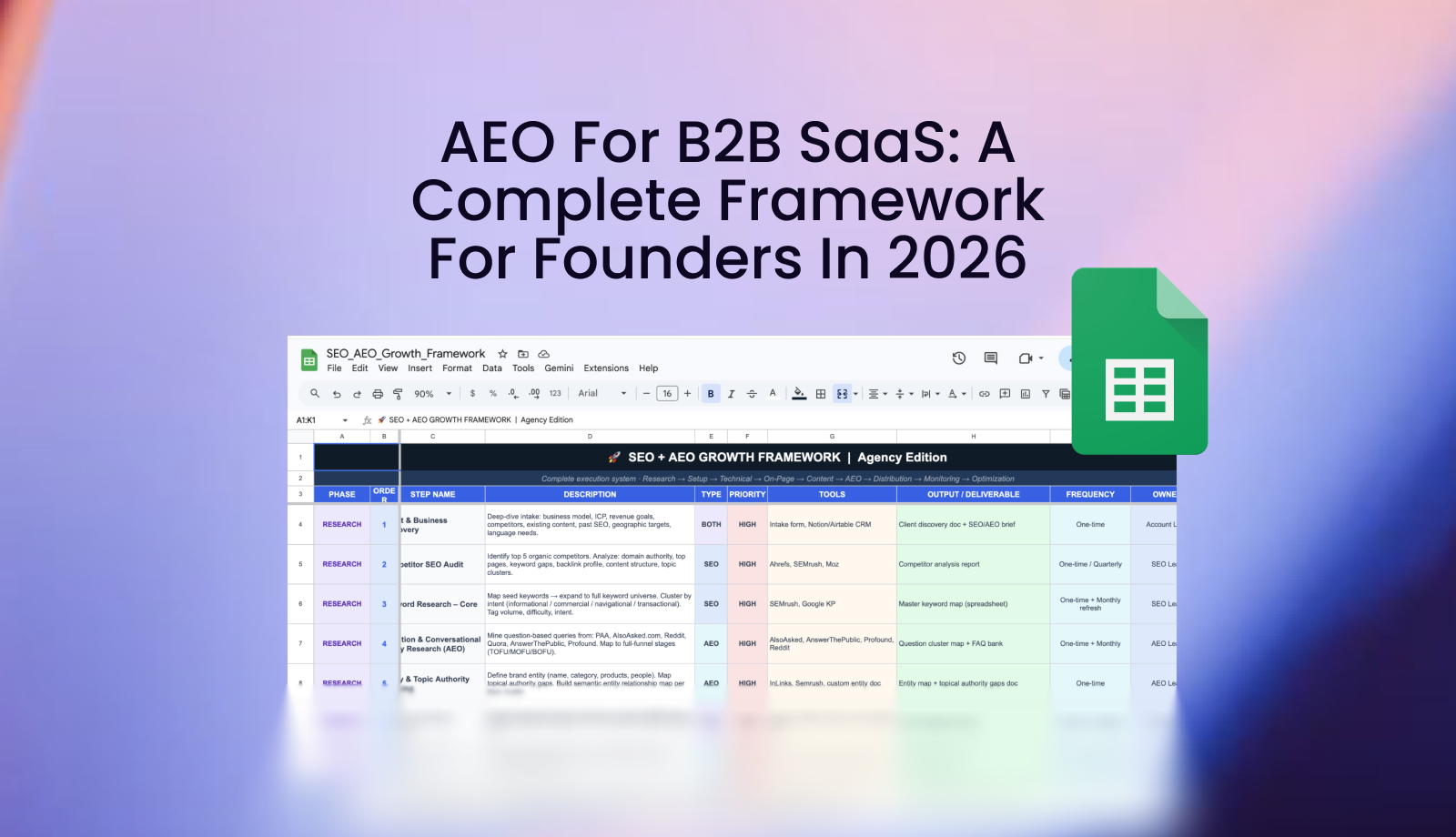
What to build: The technical AEO foundation, AI crawler access in robots.txt, an llms.txt file, FAQPage schema on all key pages, combined with content that directly answers the questions your ICP types in ChatGPT. Track your visibility with Profound or Otterly.ai. For the complete implementation system, read our full 9-phase SEO and AEO guide.
How to Build Each Signal: The Sequence That Matters
These five signals are not independent, each one depends on the one before it being resolved. Building them in the wrong order wastes budget and produces assets that need to be rebuilt when the foundation changes.
Step 1: Positioning first. Every other signal is built on positioning. Social proof needs to be selected and framed against your positioning. Visual identity communicates your positioning. Content is built around the problems your positioning defines as primary. AEO visibility targets the queries your ICP uses when they are experiencing the pain your positioning addresses. If positioning is not resolved, every downstream asset will need to be rebuilt when it is.
Step 2: Website and messaging second. Once positioning is clear, rebuild the website to communicate it. Homepage, solutions pages, and pricing page, all speaking to the enterprise buyer's pain and outcome, with clear paths for both self-serve and enterprise evaluation.
Step 3: Social proof third. Identify the case studies and testimonials that most closely match your target enterprise profile. Produce them with specific metrics. Deploy them on the website and in sales collateral before the content and AEO investment begins, because social proof is the credibility foundation that makes the content trustworthy.
Step 4: Content and AEO fourth. With positioning, website, and social proof in place, build the content system that compounds over time. Pillar pages, cluster articles, and AEO optimization, all pointing back to the website that is now built to convert the enterprise buyers the content attracts.
Step 5: Measure and iterate. Enterprise sales cycles average 120 days to close. Measure at each stage of the funnel: AI search visibility, website demo request conversion rate, deal stage progression, and win rate on enterprise deals. Track which content pieces are influencing deals. Identify where the funnel is breaking and what the brand signal gap is at that stage.
How MAD Magnet Builds This System
Every engagement at MAD Magnet follows the same sequence: diagnosis before design, positioning before content, foundation before execution.
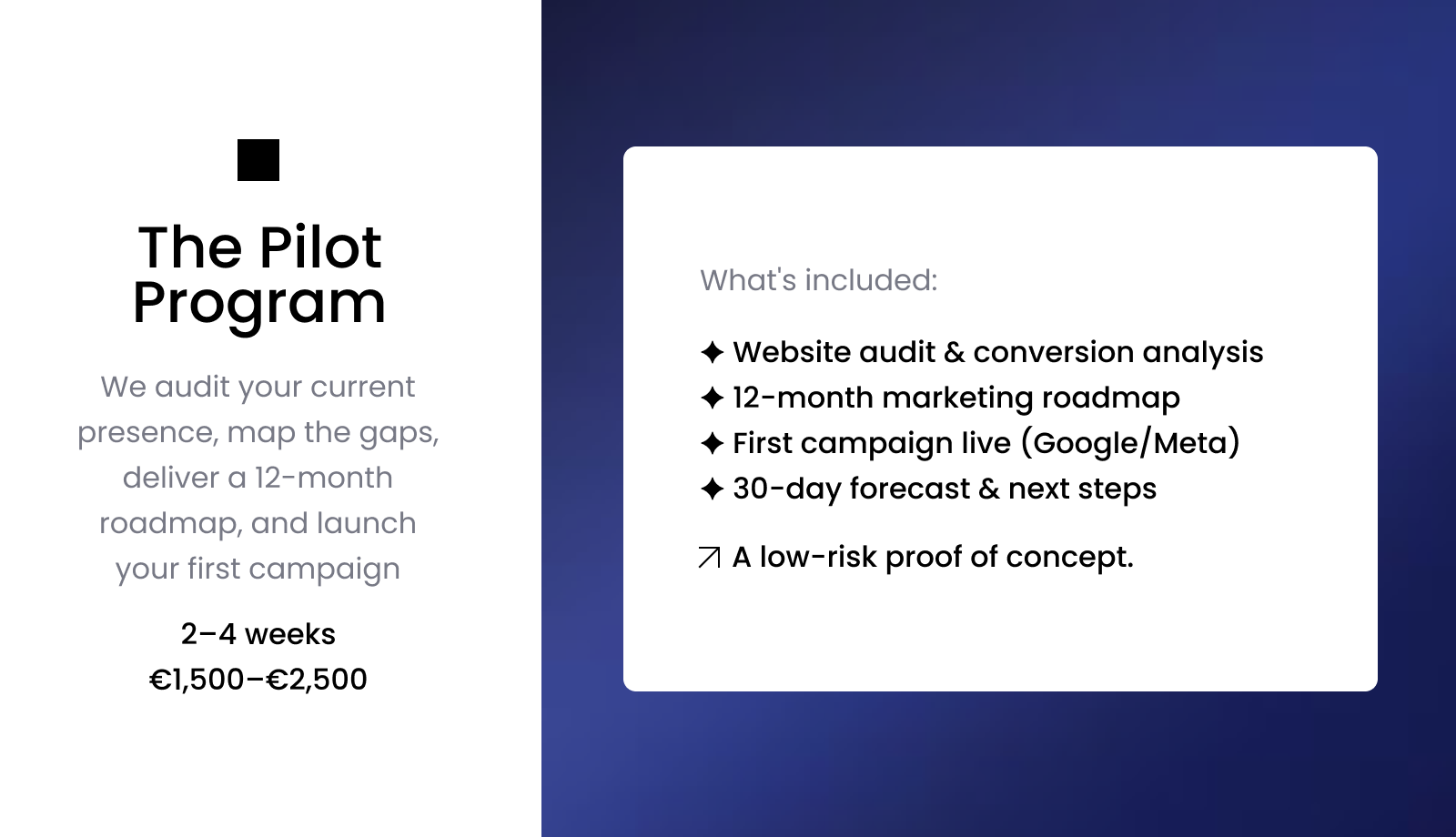
Our Pilot Program resolves positioning, ICP definition, competitive landscape, and the 12-month roadmap before we touch a single deliverable. Our Design Sprint builds the visual identity and website on that positioning foundation. Our Marketing Partner package builds the content and AEO system that compounds over time.
If you want to understand where your brand currently sits relative to what enterprise buyers expect and what the highest-leverage changes are book a free 20-minute call.
Frequently Asked Questions
What does an enterprise buyer actually look for in a B2B SaaS brand?
Enterprise buyers evaluate five brand signals before engaging sales: positioning clarity, enterprise-grade social proof, visual consistency, content that demonstrates topical authority, and AI search visibility. Missing any one of these can remove you from the consideration set before your sales team knows the opportunity existed. The signals they are not evaluating: your product's feature list, your logo design, or how many followers you have on LinkedIn.
Why do enterprise buyers not convert even when our product is better than competitors?
Enterprise buyers are not just evaluating products, they are evaluating the risk of choosing your company. A procurement committee member who approves a large contract and it fails is personally accountable. The brand signals they look for are risk-reduction signals: stability, relevant social proof, deep expertise demonstrated in content, and consistent presence in the sources they already trust. If these signals are absent, the rational enterprise buyer moves to the vendor that feels safer, even if your product is technically superior.
How long does it take to build a B2B SaaS brand that converts enterprise buyers?
The foundational work, positioning, messaging, website, and initial social proof, takes 3 to 6 months to implement. Topical authority through content and AEO visibility compounds over 6 to 12 months. Organic content has an 18-month payback period but influences 40% of enterprise deals, making it one of the most underinvested brand assets for companies at this stage.
What is the difference between a brand that converts self-serve buyers and one that converts enterprise buyers?
A self-serve brand minimizes friction between landing and signing up. An enterprise brand builds sufficient trust that a procurement committee feels confident recommending your company to their leadership. These are fundamentally different design and messaging objectives. Using self-serve brand architecture to close enterprise deals is one of the most common and most expensive mistakes B2B SaaS companies make during the PLG-to-enterprise transition.
How do I make my B2B SaaS brand visible in AI search before enterprise buyers reach my website?
Allow AI crawlers in your robots.txt, create an llms.txt file, deploy FAQPage schema on all key pages, and build content that directly answers the questions your ICP types in ChatGPT. Track visibility with Profound or Otterly.ai. For the complete implementation system, read our 9-phase SEO and AEO guide for B2B SaaS websites.
Our social proof is mostly from small companies — how do we build enterprise-grade social proof?
Identify your five best current customers who most closely match your target enterprise profile. Invest in producing detailed case studies with specific outcome metrics. Prioritize G2 and Capterra reviews from VP and C-level stakeholders. This takes 6 to 12 months of deliberate effort, but it is the credibility foundation that makes everything else in your enterprise brand system trustworthy. Without it, even the best positioning and content will struggle to convert enterprise procurement committees.
Explore more insights
.png)

.png)
The partner that makes your marketing team unstoppable
Completely free. Immediate recommendations.



.svg)


.svg)

.svg)