


.png)



How to Choose a Design and Marketing Agency for Your B2B SaaS Company
.png)
Most B2B SaaS companies choose agencies the wrong way. They check portfolio, sit through a polished pitch deck, like the team, and sign. Ninety days later they are looking at a dashboard full of impressions and MQLs their sales team will not touch.
The problem is that the evaluation process is broken, it selects for presentation quality rather than for the thing that actually matters: does this agency understand B2B SaaS pipeline generation specifically, and can they prove it with outcomes from companies at your stage?
This guide gives you the evaluation framework that separates strategic partners from production vendors before you sign anything.
What you'll learn
- Why most B2B SaaS agency evaluations fail before the first call ends
- The difference between a strategic partner and a production vendor
- 7 questions that reveal whether an agency understands B2B SaaS
- 5 red flags to end the evaluation immediately
- How to run a pilot before committing to a long-term contract
- What the right agency relationship looks like in practice
Why Most B2B SaaS Agency Evaluations Fail
The standard agency evaluation process: portfolio review, credentials call, proposal, decision is designed to select for agencies that are good at selling themselves. It does not select for agencies that are good at growing B2B SaaS companies.
The disconnect shows up consistently: the B2B SaaS market has become significantly more competitive as the market grows, and buyers are more selective than ever. Having a great product is no longer enough — and choosing the wrong agency to build your pipeline directly impacts revenue you will never recover.
Three evaluation failures cause most bad agency hires:
Evaluating on inputs rather than outcomes. Impressive portfolios, long client lists, and polished proposals are inputs. Pipeline contribution, CAC payback improvement, and ARR influenced are outcomes. Most evaluations never ask for the latter.
Not bringing sales into the evaluation. A marketing agency that does not understand your sales cycle, deal dynamics, and ICP definition will build a marketing system that generates activity disconnected from revenue. Bring your sales lead to the first call. The questions an agency asks in that room tell you whether they think in pipeline terms or in marketing activity terms.
Skipping the positioning question. An agency that wants to start producing content, running ads, or redesigning your website before understanding your positioning is applying a standard template to your business. The highest-leverage thing any marketing agency does is understand exactly who your buyer is, what they are comparing you to, and what makes your positioning defensible. If that conversation does not happen in week one, the execution that follows will be directionally wrong regardless of how well it is produced.
Strategic Partner vs. Production Vendor: The Only Distinction That Matters
Every agency you evaluate falls into one of two categories, regardless of how they describe themselves.
A production vendor executes deliverables based on briefs you provide. They are good at producing content, running campaigns, and shipping design work. They require you to have resolved strategy, positioning, and ICP definition before engaging them, because they will execute whatever brief they are given, not question whether the brief is correct.
A strategic partner starts by diagnosing before executing. They audit your current brand, positioning, funnel, and competitive landscape before proposing any deliverable. They tell you when the brief is wrong. They build systems that compound rather than campaigns that run and stop. The best SaaS marketing agencies in 2026 build top-of-funnel content that creates category awareness, run mid-funnel campaigns that capture in-market buyers, and have a clear framework for how those two connect — so you are building a system that compounds, not choosing between brand and performance.
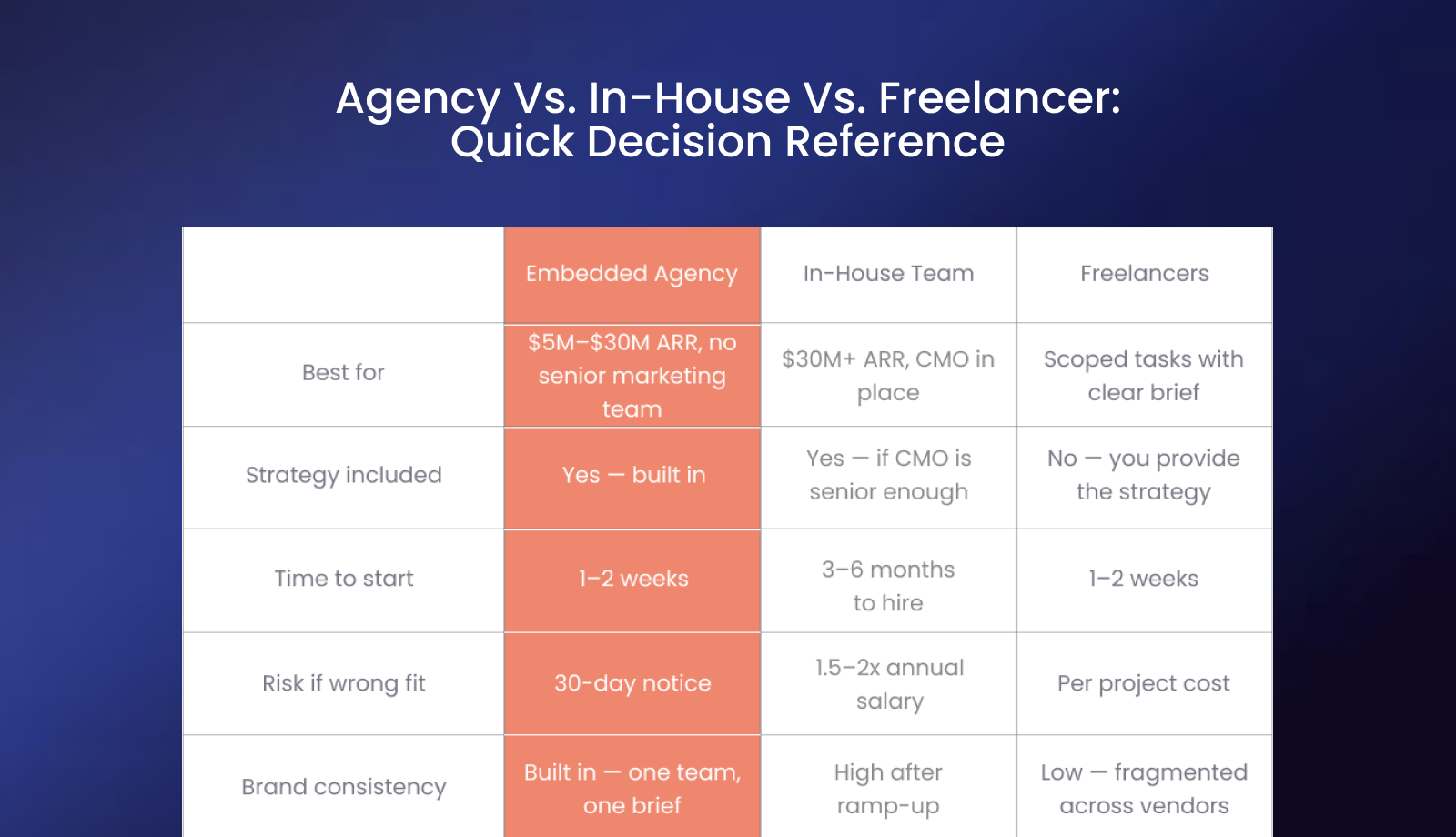
For B2B SaaS companies between $5M and $30M ARR that do not yet have a senior internal marketing lead who can manage a production vendor relationship, a strategic partner is the only model that produces compounding results. A production vendor at this stage generates activity that does not translate to pipeline, because the strategy layer does not exist to direct the activity.
7 Questions That Reveal Whether an Agency Understands B2B SaaS
Ask these in the first call. Listen for specificity. Generic answers are a reliable signal of a generalist agency applying B2B SaaS language to a standard marketing playbook.
1. Do you start with a brand and positioning audit before producing deliverables?
The right answer is yes, and they should be able to describe exactly what that audit covers: ICP definition, competitive landscape, positioning gaps, funnel audit, and messaging framework. Weak agencies start running campaigns in week one without understanding your sales cycle. Ask for a written 30-day plan before signing anything.
2. Who specifically will work on our account?
A frequent red flag is pitching with senior leaders, then handing delivery to inexperienced staff. Request the specific names and LinkedIn profiles of the people who will manage your engagement. Meet them before signing. A senior strategist with pattern recognition from dozens of B2B SaaS engagements produces fundamentally different work than a junior coordinator following a template.
3. What does onboarding look like in the first 30 days?
A strong B2B SaaS agency will describe a structured discovery process: stakeholder interviews, ICP validation, competitive analysis, funnel audit, and initial positioning hypotheses, before a single piece of content is written or a single ad runs. If onboarding means "send us your brand guidelines and we will get started," that is a production vendor, not a strategic partner.
4. How do you measure performance, what metrics map to revenue?
The answer should include CAC payback period, LTV:CAC ratio, pipeline velocity, and free trial or demo conversion rate. Impressions, reach, and engagement rate are inputs, they should appear in reporting as context, not as primary success metrics. If the agency cannot map their work to a revenue metric you track, they are not built for B2B SaaS pipeline generation.
5. Can you speak specifically to PLG-to-enterprise transition?
If you are moving upmarket, this question is non-negotiable. The positioning, messaging, and content strategy for self-serve buyers is fundamentally different from what enterprise procurement committees respond to. An agency that treats "B2B SaaS" as a single motion regardless of buyer type has not done this transition before. Ask for a specific example of a company they helped move from PLG to enterprise sales, and what changed in the marketing system to support it. Read more about what the PLG-to-enterprise transition actually requires.
6. What happens if results are not meeting targets at 90 days?
The answer reveals how the agency thinks about accountability. Strong agencies will describe a specific review process: what data they look at, how they diagnose underperformance, what they adjust, and what timeline they commit to for the adjustment to take effect. Agencies that are vague about underperformance accountability are agencies that have not built clear performance commitments into how they operate.
7. Can you share two or three references from B2B SaaS companies at a similar ARR stage?
References from companies at a different stage tell you almost nothing. A reference from a 500-person enterprise does not predict performance for a 50-person company moving into enterprise sales. Ask for references at your specific stage and call them directly. Ask three questions: Did they deliver pipeline growth? Did they understand your sales process? Would you hire them again knowing what you know now?\
5 Red Flags That Should End the Evaluation
Red flag 1: They propose execution before diagnosis
Any agency that opens with a content plan, campaign proposal, or design concept before asking about your ICP, positioning, competitive landscape, and funnel performance is a production vendor presenting a template. The template may be well-designed. It will not be built for your specific buyer.
Red flag 2: They report on vanity metrics
Watch for agencies focused on vanity metrics like clicks and impressions without evidence they impact business outcomes. If the case studies in their pitch deck show traffic growth and social engagement but not pipeline or ARR influenced, that is exactly what their reporting will look like for you.
Red flag 3: Senior people sell, junior people execute
This is the most common disappointment in agency relationships. The founder or senior strategist closes the deal. A junior account manager runs the work. Ask explicitly who will manage your account, get their names, review their experience, and insist on meeting them before signing.
Red flag 4: They cannot explain their attribution model
Ask how they track from a marketing touch to closed revenue. If they cannot describe their attribution model in plain language, how a blog view, a LinkedIn impression, or a demo request maps to pipeline and ARR, they are not operating a revenue-connected marketing system. They are running campaigns and hoping the correlation shows up in revenue at the end of the quarter.
Red flag 5: They insist on a long minimum commitment before proving anything
Agencies confident in their results accept a paid pilot. A 30 to 60-day discovery and initial execution phase with defined success metrics agreed upfront is a reasonable first step. Agencies that insist on a 6 or 12-month minimum commitment before delivering any evidence of performance are agencies that need the contract length to protect against underperformance accountability.
The Right Structure: Start With a Pilot, Scale Into a Partnership
The most reliable way to evaluate a B2B SaaS agency without a long-term commitment upfront is a paid pilot with defined success criteria.
A pilot should cover: a brand and positioning audit, ICP validation, competitive landscape analysis, initial messaging framework, and the first deliverable that tests execution quality, typically a homepage rewrite, a pillar blog post, or an initial SEO and AEO audit.
Define success before the pilot begins. Not "we will see how it goes", specific outcomes: a positioning document that your sales team confirms matches how they describe the product; an SEO audit with a prioritized action list; a piece of content that generates a defined number of qualified leads within 60 days.
If the pilot produces what it promised, the decision to continue is easy. If it does not, you have learned at a contained cost rather than six months into a contract.
At MAD Magnet, every engagement starts with a mandatory Pilot Program , brand audit, ICP definition, competitor research, positioning framework, and 12-month roadmap, before we produce a single deliverable. It is the reason 90% of our clients stay after the Pilot, not because of contracts, but because the Pilot gives them clarity they did not have before. If you want to understand what this looks like for your specific company, book a free 20-minute call.
For the full comparison, read our guide on marketing agency vs. in-house team vs. freelancer for B2B SaaS.
Frequently Asked Questions
How do I know if a marketing agency actually understands B2B SaaS?
Ask three questions in the first call: Do they ask about your ICP, ARR stage, and sales cycle before proposing anything? Can they explain the difference between demand generation and lead generation and why it matters for SaaS? Do they show pipeline and revenue outcomes from previous clients, CAC payback, ARR influenced, trial-to-paid rate, rather than impressions and follower counts? If they cannot answer all three clearly and specifically, they understand marketing in general but not B2B SaaS specifically.
What questions should I ask a B2B SaaS marketing agency before signing?
Seven questions that separate strong B2B SaaS agencies from generalists: Do you start with a brand and positioning audit? Who specifically will work on our account? What does onboarding look like in the first 30 days? How do you track performance to revenue? Can you speak to PLG-to-enterprise transition specifically? What happens if results miss targets at 90 days? Can you share references from B2B SaaS companies at a similar ARR stage?
What are the red flags when evaluating a B2B SaaS marketing agency?
Five red flags: they want to start producing content before a brand and positioning audit; they report on impressions and reach rather than pipeline metrics; they pitch with senior people but hand execution to juniors; they cannot explain their attribution model; and they insist on a long minimum commitment before proving anything. A serious agency asks different questions than a production shop, and is willing to prove results on a paid pilot before asking for a long-term contract.
Should I hire a full-service agency or a specialist agency for my B2B SaaS company?
A full-service embedded agency makes the most sense when you need strategy and execution together across brand, design, content, and SEO, and when you do not have a senior internal marketing lead who can manage multiple specialist agencies simultaneously. A specialist agency makes sense when you have clear positioning, a defined channel hypothesis, and an internal strategist who can integrate the specialist's work into a coherent system. Most B2B SaaS companies between $5M and $30M ARR need the former.
How much should a B2B SaaS company pay for a marketing agency?
Embedded B2B SaaS marketing agency retainers in 2026 typically range from €3,500 to €10,000 per month. The right question is not what the retainer costs, it is what the cost-per-outcome is relative to building the same capability in-house. A full in-house team covering strategy, design, content, and SEO costs $300K–$600K annually in salaries before benefits. An embedded agency delivers equivalent capability for a fraction of that cost, with a 30-day exit if performance does not meet targets.
What is the difference between a design agency and a marketing agency for B2B SaaS?
A design agency focuses on visual identity, website design, and brand assets. A marketing agency focuses on strategy, content, SEO, paid media, and pipeline generation. For B2B SaaS companies, the most dangerous mistake is treating these as separate projects with separate briefs, because design that is not built on positioning and ICP research produces visually strong work that does not convert enterprise buyers. The most effective model integrates design and marketing strategy from the same foundation. This is what our Design Sprint and Marketing Partner packages are built to do together.
Explore more insights
.png)

.png)
The partner that makes your marketing team unstoppable
Completely free. Immediate recommendations.



.svg)


.svg)

.svg)