The launch post goes up on the company page, and someone in marketing drops a message in the all hands channel: "Please share!"
Over the next hour, thirty people repost it. Most add nothing. A few add "Big day!" Anyone who follows several of them now sees the same caption four times in a row, with the same screenshot, from people whose actual jobs have nothing to do with each other.
Marketing in #general: Please share!!! Link in thread
Ana, sales: Big day for the team!
Marko, engineering: Big day for the team!
Ivana, finance: Big day for the team!
Anyone who follows all three: so... big day?
Nothing about that is wrong, exactly. It's just a waste of the most valuable thing the company has on social.
Thirty different people, each trusted by a different slice of the market, all saying one thing in one voice.
The CTO is believable on architecture in a way the CEO isn't. A salesperson knows which objection comes up in every third call. Customer success knows which workflow customers actually love. Social works when each of those people posts what only they can say, to the buyers who already listen to them. This article goes through it role by role, with examples from Deel, Clay, Supabase, Ramp and Gong.
Key takeaways
- Your employees' combined networks are about 12 times larger than your company page's following.
- At Deel, the CEO drove 55% of the team's engagement on LinkedIn. The other 45% came from people posting in other languages, for other markets.
- Every role has one thing only it can say and one thing it should never post.
- Three to five consistent voices beat thirty occasional ones.
- The program dies without one owner who keeps the voices going every week.
Your People Reach 12 Times More Buyers Than Your Company Page
Start with the math. LinkedIn's own data says the combined networks of a company's employees are about 12 times larger than the company's following. The same data shows that 75% of decision makers say thought leadership is a more trustworthy way to assess a company's capabilities than its product sheets or marketing materials.
You can see what that looks like at scale in Deel. Postiv, a LinkedIn tool, analyzed 916 posts from 40 Deel employees with public LinkedIn activity in the spring of 2026. The list included the CEO and the CTO, but also account executives, a sales leader for the DACH region posting in German, a marketing manager in Brazil posting in Portuguese and English, the global head of talent acquisition, and a senior product designer.
Share of Deel's team engagement on LinkedIn, spring 2026
Source: Postiv's analysis of 916 public postsThe CEO accounted for 55% of the team's engagement. The other 45% came from people the CEO doesn't replace: they post in other languages, for other markets, about other specialties.
That's the point of mapping roles. Not more posts. More of the market, reached by someone it already trusts.
What Each Role Can Say That Nobody Else Can
Here's the map. For each role: what they're credible on and who they reach.
Who says what, to whom
| Role | What only they can say | Who they reach |
|---|---|---|
| CEO, founder | Why now. Where the market is going. | Economic buyers, investors, founders |
| CTO, engineers | How it works. What was hard to build. | Technical evaluators |
| Product | When and why to use it. | Daily users, internal champions |
| Marketing lead | What the market is telling us. | Marketing and revenue leaders |
| Sales | The questions buyers actually ask. | Active evaluators |
| Customer success | What good looks like after signing. | Customers, late stage evaluators |
| People team | What it's like to work here. | Candidates, anyone vetting the team |
| Company page | Launches, proof, resources. | Everyone who follows the brand |
Each role has its own audience.
The CEO or founder: why now
The CEO is credible on direction: where the market is going, why the company exists, what it believes that competitors don't. They reach investors, other founders and economic buyers, the people who sign off on the budget. And LinkedIn is where they show up: of the Fortune 500 CEOs on any social platform, 98% are on LinkedIn, according to Influential Executive (2024). Company moments belong here too. Deel CEO Alex Bouaziz's most liked post in Postiv's sample was about a $300 million raise.
When the CEO starts posting release notes, the most valuable voice in the company turns into a second company page.
Founders don't have to write to be heard. Some of the most watched founder content is a short clip cut from a long interview. In September 2025, a16z posted a 22 second clip of Marc Andreessen, who helped build Mosaic, the first widely used web browser, explaining why links are blue. The short version: he liked blue. A breakdown by @bephrem counted 6.8 million impressions three days later, on an account whose clips usually get 20,000 to 100,000.
Almost everything that made it travel can be repeated:
- It works muted. Captions appear word by word, right next to the speaker's eyes, so nobody has to turn the sound on.
- It moves in the first four seconds. Four cuts before most people decide whether to keep scrolling.
- It's short. One question, one answer, and not a second that could be cut.
- It's square. It takes up twice the height of a horizontal video in the feed.
- It has a story. A famous person, a question nobody thought to ask, and a joke at the end.
None of it needed a studio. It needed one good interview and an editor willing to cut everything else.
The CTO and engineers: how it works
Technical buyers don't trust marketing copy about architecture. They trust the people who built it. The CTO and senior engineers can explain what was hard to build, the trade-offs they chose, and why the product works the way it does. Supabase built its launches around this: co-founder Ant Wilson wrote that with most features, the engineer who implements it also writes its marketing content, and is usually the best person to decide which communities it should go to.
Product and design: when and why to use it
Product managers and designers are credible on use cases, roadmap thinking and the decisions behind the interface. They reach daily users and the champions who will push for your product internally. Deel's senior product designer shows up in Postiv's list with posts that never mention Deel at all. They're about design, AI workflows and building products, and that's exactly why they work.
Marketing leaders: what the market is telling us
The CMO or head of marketing is credible on buyer behavior, research and market patterns, the things they see across hundreds of conversations and campaigns. At Clay, Head of Marketing Bruno Estrella posts to marketing and revenue leaders, one of three buyer groups Clay mapped its people to. Our Clay teardown walks through the full map.
Sales: the questions buyers actually ask
Salespeople hear the real objections, the competitor comparisons, the internal politics of a deal. Posted honestly, that's some of the most useful content a buyer can find, because it answers the questions they're about to ask. Deel's list includes several account executives and sales leaders, some posting in the language of the market they sell into.
Customer success: what good looks like
Customer success is credible on outcomes: which workflows customers love, what the best accounts do differently, the mistakes new customers make in month one. They reach existing customers, which makes them the most underused voice for adoption, and evaluators who want to know what life after signing looks like.
The people team: what it's like to work here
Recruiting and people leaders carry the employer brand. At Deel, the global head of talent acquisition published 89 posts in Postiv's sample, more than the CEO. That matters for hiring, and it matters to buyers more than most teams think, because "who are these people?" is a question every evaluator eventually asks.
The company page: the source of truth
The company page is where launches, product news, proof and resources live, so everyone else has something to point to.
It works because the page has one job and the people around it have theirs.
Outside voices: customers, partners and creators
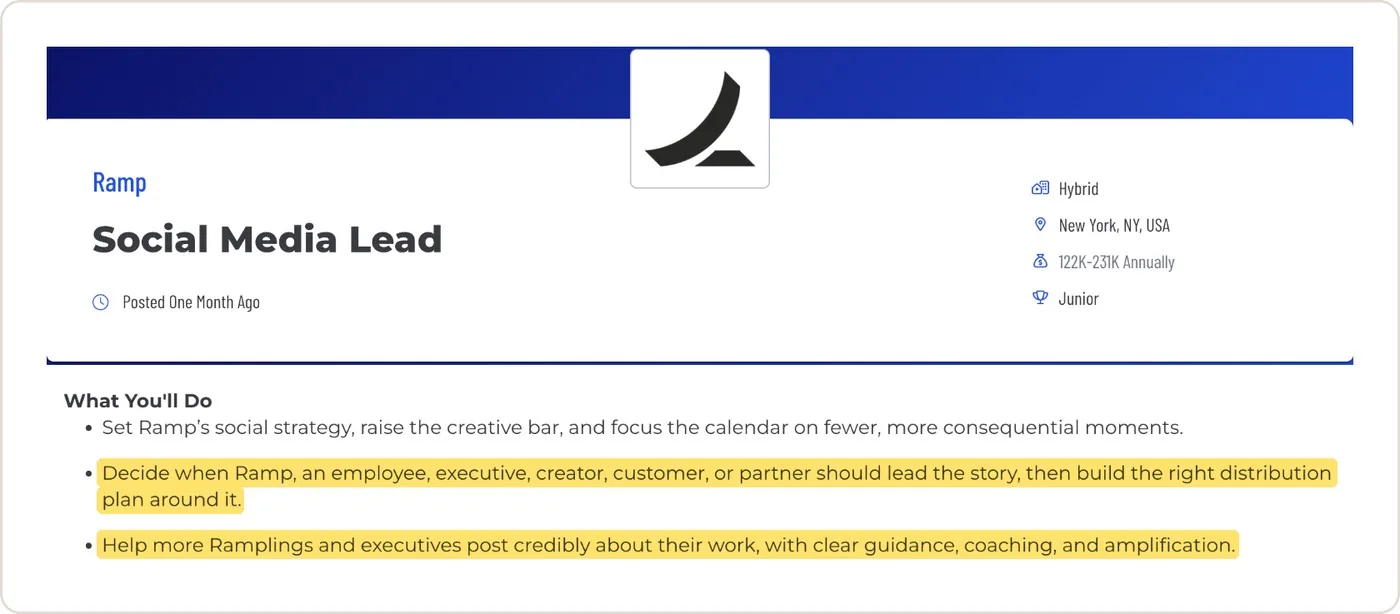
Some stories land better when someone outside the company tells them. Ramp made deciding who tells the story an explicit part of its Social Media Lead role: "Decide when Ramp, an employee, executive, creator, customer, or partner should lead the story, then build the right distribution plan around it."
That sentence is a good test for any post on your calendar. Before asking how to write it, ask who should be saying it.
What to keep each role away from
| Role | Keep them away from |
|---|---|
| CEO or founder | Feature lists and release notes |
| CTO and engineers | Sales language. One "book a demo" costs more credibility than ten good technical posts earn |
| Product | Roadmap dates in public |
| Marketing leaders | Reposting the campaign assets the company page already posted |
| Sales | Pitching in posts. The pitch happens in the DMs, when the buyer asks for it |
| Customer success | Customer details without permission |
Three to Five Voices Beat Thirty
None of this means every employee should be on a posting schedule. Most companies get further with three to five consistent voices, each matched to a buyer group, than with thirty occasional ones.
Always on
Every week, to one buyer group
Usually the CEO, one technical voice, one product or marketing voice, and the company page.
Moment voices
Around launches, events, funding and hiring
Gong's "LinkedIn takeovers" had employees at every level post on the same day around one company moment.
Start with the always-on voices. Add moment voices once the always-on ones have a rhythm. Our Gong teardown covers how its marketing team trained people instead of posting for them.
Some teams do grow past that, and the ones that work keep it light. Sandra Djajic from Chatbase describes how they took founder-led posting to the whole team: sales, product, engineering and marketing each post what they see from their own seat. The setup is simple. A shared library of company wins, product updates and insights that anyone can rewrite in their own words. A weekly prompt: what you shipped, what you heard on a customer call, an opinion you can back with data. And an honest pitch to the people posting, that it builds their own network and visibility too. Asked what the hardest part is, she didn't name a tool or a format: "Founders and teammates standing in front of product."
One Asset, Six Angles
The thirty identical reposts from the opening happen because there's one asset and one caption. The fix is to plan angles, not shares.
Take a single piece of work, say a benchmark report built from your product data. The CEO posts the headline finding and what it says about where the market is going. The marketing lead posts the implication for buyers. A salesperson posts the question from the report that prospects ask most. Customer success posts what the best customers do differently. An engineer posts how the data was collected. The company page posts the report and the download link.
One assetA benchmark report
The headline finding and where the market is going
What it means for buyers
The question prospects ask most
What the best customers do differently
How the data was collected
The report and the download link
Same asset, six reasons to stop scrolling, six different audiences reached.
Coordination Is the Job Nobody Owns
Mapping voices is the easy part. Keeping them going is where most programs fail, because nobody owns it.

Look at how Ramp writes the job.
At Clay, the program has a single owner who runs weekly sessions with executives and follows up in Slack between them. At Gong, marketing's core job was training and enabling people to post. In practice, coordination is a short list somebody has to work through every week:
- Keep a voice map: who speaks to which buyer, about what
- Set a monthly theme tied to the quarter's business priority
- Turn each big asset into angles for each voice
- Keep a shared library of wins, updates and insights people can rewrite in their own words
- Interview busy leaders instead of asking them to write from scratch
- Make approvals fast enough that posts are still relevant when they go out
- Track each voice separately, by who's viewing and what conversations it starts
If nobody has that on their list, the program quietly turns back into thirty people reposting one caption.
Back to the All Hands Channel
Picture the same launch with a map behind it. The company page posts the announcement. The CEO explains why the market needed it. An engineer posts what was hard to build and shares it in a developer community. The product lead posts a two minute walkthrough. A salesperson posts the objection the feature finally answers. Two customers from the beta say what changed for them.
Nobody asked anyone to "please share." Everyone posted what only they could say.
Want to see what your company's voice map could look like? That's part of a Social System Review: we map your buyer groups, the people inside your company each group trusts, and the gaps between them.