The feature took a quarter to build. On Tuesday at ten, the company page publishes the announcement: a screenshot, a link, and a caption that starts with "We're excited to announce." By lunch it has forty reactions. 38 of them are from people who work there.
Launch post: 40 reactions
38 of them: people who work here
1 of them: the CEO's mom
The last one: a recruiter
Pipeline: still zero
Sales finds out from Slack. Customers find out from an in-app banner they close without reading. A month later the retro concludes that the feature "didn't land."
The feature was fine. The launch never happened, because a post is not a launch.
A launch on social is a distribution plan: who the feature is for, who those buyers already trust, what each of those people should say, and what keeps the story going after day one. Below is that plan in seven steps, in the order you'd actually build it.
Key takeaways
- Only about 5% of B2B buyers are in market at any time. A launch has to move them now and be remembered by the other 95%.
- Size the launch first. Not every feature deserves a countdown.
- Write one sentence per buyer group before anyone makes an asset.
- The voices that carry a launch furthest are people your buyers already trust. Give them something that makes them look good, not a caption to post.
- Launch day is a sequence, and most adoption happens in the 30 days after.
Step 1: Decide How Big the Launch Is
Most teams give every release the same treatment, a post and a banner, which means the big ones get too little and the small ones train the feed to scroll past. Size it first.
Three launch tiers
| Tier | What it is | What it gets |
|---|---|---|
| Update | A small improvement or a fix | A changelog line and one post from the product lead |
| Feature | Changes how customers work | The full plan below: voices, launch day, 30 days after |
| Category moment | Changes your position in the market | Everything above, plus a pre-launch phase with a waitlist |
For the third tier, anticipation is worth building because it turns attention into a list. When Notion opened access to Notion AI in early 2023, its waitlist had drawn more than two million signups. The mechanism scales down: a waitlist lets the buyers who are ready raise their hand before launch day, and it tells you who to talk to first. Teasers that say "something big is coming" with no detail give the feed nothing to hold on to. Show the problem, the person building the fix and the beta users who already tried it.
Step 2: Write Three Sentences Before You Make Anything
Professor John Dawes of the Ehrenberg-Bass Institute estimates that only about 5% of B2B buyers are in market at any given time. LinkedIn's B2B Institute built the 95:5 rule on it. So a launch has two jobs: give the 5% a reason to act now, and give the 95% a reason to remember you when their own trigger arrives.
In practice, one feature matters to at least three groups for three different reasons. Write what each one needs to believe after the launch, then let everything else follow.
One feature, three buyers
| Buyer group | What they need to believe | Who says it | Format |
|---|---|---|---|
| Existing customers | "It's worth turning on, and here is how." | Product lead, customer success | Short walkthrough, tutorial post |
| Evaluators | "They just closed the gap we were worried about." | Sales, beta customers, a creator they follow | Customer story, honest comparison |
| The wider market | "This company sees where the category is going." | CEO, the engineer who built it | Point of view post, build story |
Write the second column first. Everything else follows from it.
Borrow the words from your buyers. Before you write the three sentences, read the comments, community threads and sales call notes where they describe the problem in their own language. The phrases they use are the ones that make them stop scrolling, and they're rarely the ones in your product marketing deck.
If you can't write those three sentences, the launch isn't ready, no matter how good the video is.
Step 3: Find the People Your Buyers Already Trust
The reach is already there. LinkedIn's data says your employees' combined networks are about 12 times larger than your company page's following. Inside the company, each voice reaches a different buyer:
| Voice | What they say | Who it lands with |
|---|---|---|
| CEO or founder | Why now: what changed in the market | The wider market, economic buyers |
| Product lead | When and how to use it, with real use cases | Existing customers |
| The engineer who built it | How it works and what was hard | Technical evaluators |
| Customer success | Answers to the questions of week one | Existing customers |
| Sales | The feature as the answer to the top objection | Evaluators |
| Company page | The announcement and the link | Everyone who follows the brand |
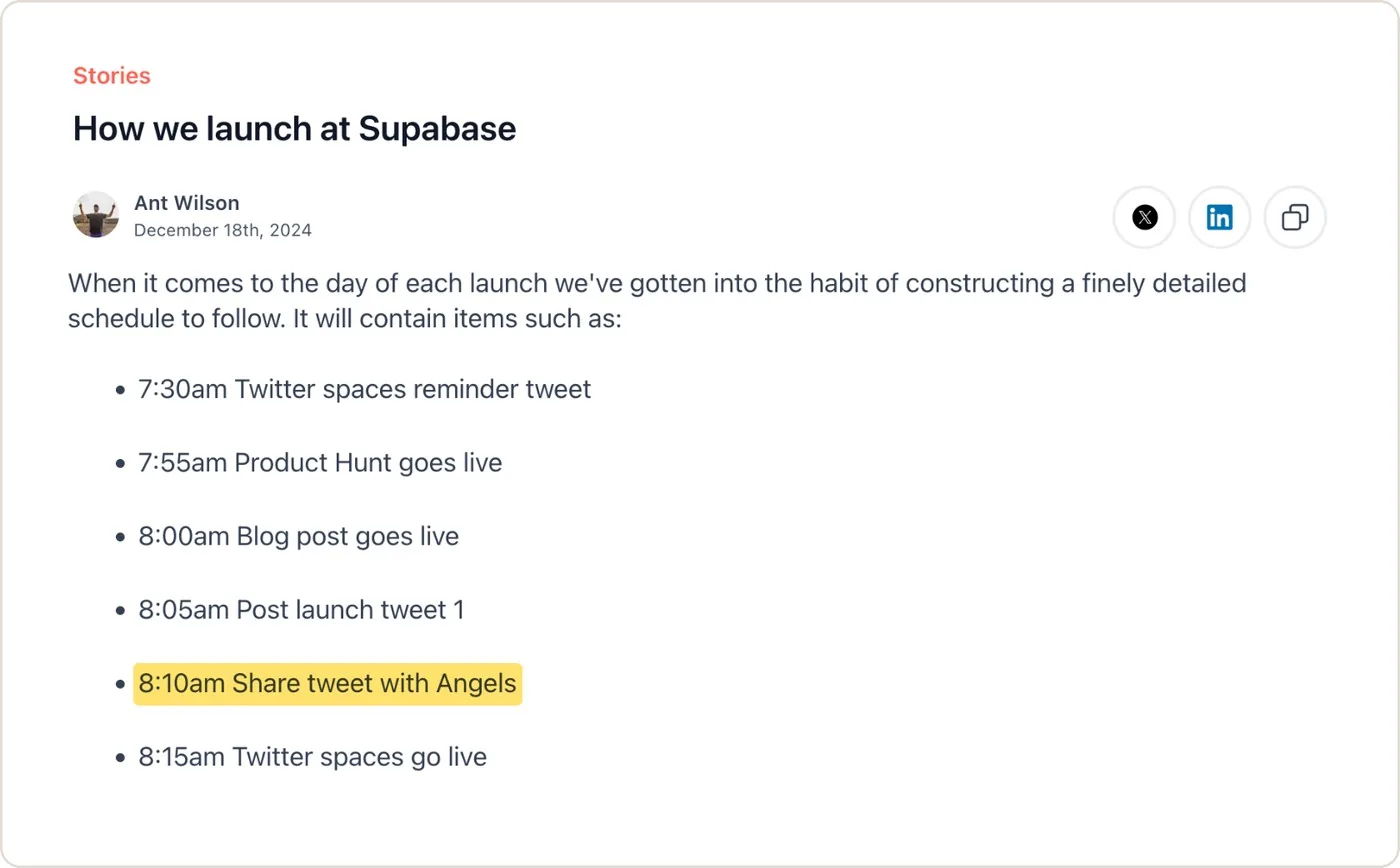
Supabase takes the engineer row further than most. Cofounder and CTO Ant Wilson wrote that with most Supabase features, the person who implemented the code is the same person who writes the marketing content.
The voices that carry a launch furthest, though, often don't work for you. A beta customer, an integration partner, an advisor, a practitioner your buyers follow. The right ones share four things:
- They already use the product or believe in the problem it solves
- The buyers you want already listen to them
- They have a true story of their own: a result, a workflow, a migration
- Being part of your launch makes them more visible, not less
Pick them for fit, not size. A practitioner followed by 15,000 of the right people will move a launch further than a general tech influencer with ten times the audience. And it pays to treat this as a program rather than a single favor: in TopRank Marketing's 2025 B2B influencer marketing report, 43% of marketers said their influencer programs got outstanding results, and among teams with mature programs that number was 79%.
Then flip the usual ask. Don't ask them to say nice things about your feature. Give them something that makes them look good to their own audience: early access and a story only they can tell, data they get to publish first, a clip of their part in your live demo, a template built on their workflow, credit and a link back to them in every company post. A story people can share is a gift. A request to promote your feature is a favor, and favors don't compound.
This isn't sponsored content. A paid endorsement reads as an ad. A customer explaining, in their own words, what changed for their team reads as proof. And it works on the decision itself: LinkedIn reports that nearly half of buyers in the decision phase visit a vendor's website after engaging with creator content.
For a launch aimed at evaluators, one customer walkthrough can do more than ten company posts.
The full map, role by role, is in What Every Role in Your Company Should Post.
Step 4: Send Every Voice a Brief and a Kit
Two weeks out, every person who will post gets one page. Not a caption to copy: thirty identical captions are how a launch turns into noise.
- The feature in one plain sentence, without the product marketing words
- The buyer sentence for the audience this person reaches
- Their angle: the one question only they can answer
- Assets they can use: a short clip that works with the sound off, two or three screenshots, one diagram
- Their own tracked link, so you can see whose post moved whom
- Their posting window on launch day and who replies to comments
Partners and customers get the same kit, plus a draft they're free to ignore. Most will rewrite it in their own voice, which is the point.
Step 5: Run Launch Day as a Sequence
Timing matters more than polish. Supabase plans launch day to the minute, and one line in Ant Wilson's write-up is easy to miss: at 8:10, the launch goes to Supabase's angel investors.
A run sheet that works for most B2B teams:
Launch day run sheet
| When | Who | What |
|---|---|---|
| Hour 0 | Company page | The announcement and the link, so every other post has something to point to |
| Hours 1 to 3 | CEO, product lead, engineer | Each from their own angle, in their own words |
| Hours 3 to 6 | Beta customers, partners | Their own story, with a link back |
| All day | Everyone who posted | Answer comments, add the detail, thank people by name |
| End of day | Social lead | Collect the best questions for week two |
Gong built a whole format on hours one to three. Its "LinkedIn takeovers" put tens of employee posts live on the same day around one moment, so momentum built in the feed instead of fading (our Gong teardown). Clay orchestrated launches across the company account, executives, the team and partners, with one person responsible for the rhythm (our Clay teardown).
Step 6: Plan the 30 Days After
Most launch plans end on launch day, exactly when the customers who need the feature most still haven't noticed it. Supabase's first Launch Week, in March 2021, shipped seven features one after another instead of a single announcement. One feature can carry a month.
Three things make this compound. Give the conversation a room: a live session or an open thread where beta customers and prospects talk to each other, not just to you. A peer saying "we use this for exactly that" is worth more than anything you can post. And keep a list of everyone who engaged: the customers who commented, the partners who posted, the prospects who asked. They are the voices of your next launch. And put budget behind what already works. In Dreamdata's 2026 benchmarks, LinkedIn Ads returned 121% ROAS, ahead of Google Search at 67% and Meta at 51%. The posts buyers already responded to on their own are the ones worth promoting, ideally as Thought Leader Ads from the person who wrote them.
Sandra Djajic from Chatbase has a name for this: content isn't the moat, distribution loops are. For a launch, the loop looks like this: the long post becomes clips, the clips become posts from each voice, the posts feed the newsletter, and the newsletter points to the demo or template that gets people to sign up. Each step hands the next one an audience.

Step 7: Measure What the Launch Was For
Likes on the announcement tell you almost nothing. Go back to the three sentences from step two.
What to measure, and where
| Buyer group | What to measure | Where to find it |
|---|---|---|
| Existing customers | Feature adoption, support questions that show people trying it | Product analytics, support inbox |
| Evaluators | Demo requests and signups from launch links, launch mentions on sales calls | Tracked links, CRM, "How did you hear about us?" |
| The wider market | Who viewed the posts by job title, industry and company size; new followers from the right roles | LinkedIn analytics for each voice |
Decide before launch day what you will look at after it.
If the numbers disappoint, diagnose before you fix anything. The first instinct is new visuals, a new audience or more posts. The better question is what actually broke: the three sentences, the people who posted, the landing page, the tracking, or the feature itself. More posting fixes none of those.
The Launch on One Page
| Six weeks out | Launch day | The 30 days after |
|---|---|---|
| Size the launch and write the three sentences Marketing | Company page posts first, with the link Social lead | Live demo, then clips per buyer group Product |
| Pick the inside and outside voices Marketing | CEO, product lead and engineer post within hours Each voice | Answer the most asked questions, one post each Sales, CS |
| Send briefs and kits to everyone who posts Social lead | Customers and partners post their own story Partners | First customer story CS |
| Open a waitlist for category moments Product | Everyone answers comments Whole team | Measure against the three sentences Marketing |
| Collect proof from beta users, with permission to share Product, CS | Sales and support give the same answers as the posts Sales, CS | Rewrite the three sentences with what buyers actually said Marketing |
Back to Tuesday at Ten
Run the same feature through this plan and the Tuesday post is still there, but it's the first of thirty moments instead of the only one. The CEO explains why the market needed this. The engineer's post gets shared in a community the company page never reached. The beta customer's story lands with the evaluators who were comparing you last month, and customers hear about the feature from a person instead of a banner.
The feature didn't change. The launch did.
Planning a launch this quarter? A Social System Review is where we start: we look at the launch, the people who could carry it, and the gaps between the two.