

Webflow vs Framer vs WordPress for B2B SaaS Websites: Which Platform Is Right for You in 2026
.png)
.png)
The platform your B2B SaaS website runs on is not just a technical decision. It determines how fast your marketing team can move, how well your website performs in Google and AI search, and whether the site can scale alongside your content strategy without requiring a developer for every update.
Webflow, Framer, and WordPress each represent a fundamentally different philosophy, and the right choice depends entirely on your ARR stage, team capabilities, content plans, and whether you are building for self-serve buyers or enterprise procurement committees.
This guide gives you a direct comparison based on what actually matters for B2B SaaS companies in 2026: SEO and AEO capability, content scale, team workflow, design flexibility, total cost of ownership, and fit for enterprise positioning.
What you'll learn
- What each platform does best and where each one fails
- Which platform wins for SEO and AEO for B2B SaaS
- Which platform is right for your ARR stage
- Total cost of ownership comparison
- When to choose Webflow, Framer, or WordPress
- What to consider if you are rebuilding for enterprise buyers
The Short Answer: Which Platform for Which Stage
Before the full comparison: if you need a quick decision based on stage, here it is.
Framer: Best for early-stage SaaS (pre-$5M ARR) or product launches where you need a visually impressive site live in two weeks. Not the right choice if your growth plan includes content marketing.
Webflow: Best for B2B SaaS companies between $5M and $50M ARR that need design flexibility, clean SEO and AEO implementation, and a site their marketing team can manage without developer dependency.
WordPress: Best when you need deep content architecture at scale (100+ CMS items, complex linked collections), specific third-party integrations not available in Webflow, or when you have a technical team comfortable managing the WordPress ecosystem long-term.
For B2B SaaS companies building or rebuilding their website to target enterprise buyers, Webflow consistently outperforms the alternatives on the criteria that matter most: faster time to launch, design control, all-in-one hosting, and clean SEO implementation without plugin dependencies.
Platform Overview: What Each One Actually Is
Webflow
Webflow is a visual web development platform that gives designers CSS and HTML-level control through a visual interface, without requiring traditional code for most tasks. By 2026, it has matured into a serious platform powering agencies, startups, and growing B2B companies globally. It includes hosting, CMS, native SEO controls, and an expanding set of integrations.
Webflow is the platform where design freedom and marketing team independence intersect most cleanly. Once a Webflow site is built by a developer or agency, a non-technical marketing team can update content, launch new pages, and iterate on copy without engineering involvement.
Framer
Framer is optimized for speed and visual polish. The experience feels similar to working in Figma, idea to live website quickly, with exceptional motion design and animation capabilities. This is why many early-stage startups and AI companies prefer Framer for marketing websites. It is the fastest path from design to live site.
The constraint: Framer's CMS is limited, its SEO depth is still catching up, there is no code export (you are fully locked into the Framer ecosystem), and it is not built for content-heavy sites. If your growth plan includes a blog, topical authority building, or complex content architecture, Framer will become a constraint within 12 months.
WordPress
WordPress powers roughly 43% of all websites in 2026 a number that reflects its unmatched flexibility and ecosystem depth. For B2B SaaS companies that need deep SEO control, complex content structures, specific third-party integrations, or large-scale content operations, nothing comes close to what WordPress can do.
The cost of that flexibility is real: plugin bloat, maintenance overhead, security management, and performance optimization all require ongoing attention, and often developer involvement, that most B2B SaaS marketing teams are not resourced to manage well.
SEO and AEO: Which Platform Wins for B2B SaaS Organic Visibility
For a B2B SaaS company building topical authority through blogging and aiming to be cited in ChatGPT and Perplexity, platform choice directly affects how fast that visibility compounds.
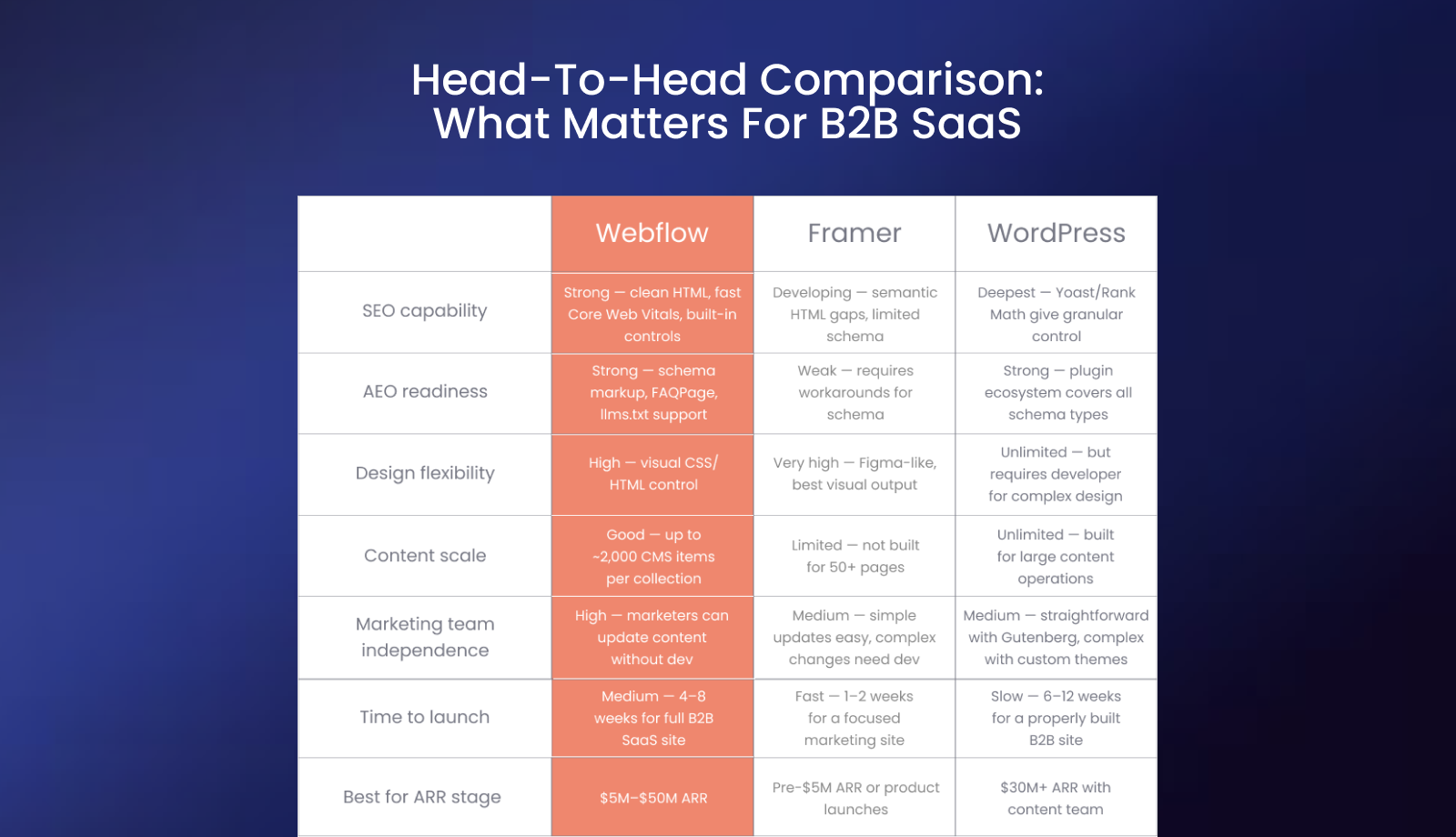
WordPress wins on raw SEO depth. Plugins like Yoast SEO and Rank Math give granular control over every SEO element, meta titles, descriptions, canonical tags, XML sitemaps, schema markup, and more. For B2B SaaS companies running large content operations (50+ blog posts, multiple content types, complex internal linking), WordPress's SEO ecosystem is the most mature and most flexible.
Webflow wins on SEO fundamentals without maintenance overhead. Webflow produces clean semantic HTML, fast-loading pages, and strong Core Web Vitals performance out of the box, without requiring plugin management or developer intervention. For most B2B SaaS companies between $5M and $30M ARR, Webflow's built-in SEO controls are sufficient for strong organic performance.
For AEO specifically, getting cited in ChatGPT, Perplexity, and Google AI Overviews, both Webflow and WordPress support the key requirements: FAQPage schema, Article schema, HowTo schema, Organization schema, and the technical setup needed for AI crawler access. Framer requires more workarounds for schema implementation and has notable gaps in semantic HTML structure.
For the complete AEO implementation checklist compatible with both Webflow and WordPress, read our full 9-phase SEO + AEO guide for B2B SaaS websites.
Rebuilding for Enterprise Buyers: What Platform Decisions Actually Matter
When a B2B SaaS company rebuilds its website to target enterprise buyers, moving from self-serve positioning to enterprise credibility, several platform-specific decisions become critical.
Design control matters more than you think
Enterprise buyers evaluate brand signals in seconds. A website that looks like a template, even a good template, communicates startup, not enterprise. The platform needs to give your design team sufficient control to implement a differentiated brand identity, not just customize a theme. Webflow and Framer both allow this. WordPress requires more developer involvement for truly custom design.
Marketing team independence is non-negotiable at scale
An enterprise website needs constant iteration, new case studies, updated messaging, new landing pages for specific verticals. If every update requires a developer, iteration slows to a pace that kills momentum. Webflow gives marketing teams the highest degree of independence for post-launch updates.
Content architecture determines long-term SEO performance
On a B2B resource hub with 140+ CMS items — authors, categories, gated downloads, and product references connected across collections — Webflow was the better foundation compared to Framer. If your enterprise content plan includes extensive blogging, multiple content types, and complex internal linking structures, plan for this in the platform decision before the build begins.
Performance directly affects enterprise conversion
Enterprise buyers researching vendors are not patient. Slow load times signal technical debt, a risk signal for companies evaluating a vendor they will integrate with their own systems. Webflow and Framer both deliver consistently strong Core Web Vitals performance. WordPress requires active performance optimization to achieve the same results.
When to Choose Each Platform
Choose Webflow if:
- You are between $5M and $50M ARR and need a site your marketing team can manage independently
- You are rebuilding your website to target enterprise buyers and need design control without developer dependency
- You plan to build topical authority through a growing blog (up to ~200 posts) and need clean SEO and AEO implementation
- You want all-in-one hosting, CMS, and SEO without managing a plugin ecosystem
- Your team includes designers familiar with CSS and HTML concepts
Choose Framer if:
- You are pre-$5M ARR and need a visually exceptional site live in under two weeks
- You are launching a specific product or campaign and need maximum visual impact quickly
- Your site is focused on conversion rather than content, fewer than 30 pages, minimal blogging
- You are a design-led team that prioritizes visual output over content scalability
Choose WordPress if:
- You are at $30M+ ARR with a dedicated content team and technical resources to manage the platform
- You need deep content architecture — 100+ posts, multiple linked CMS collections, complex content types
- You require specific third-party integrations not available natively in Webflow
- You need maximum SEO control and flexibility for a large-scale content operation
- Your team includes developers comfortable managing the WordPress ecosystem long-term
If you are deciding between platforms as part of a broader website rebuild for enterprise buyers, this is exactly the type of strategic decision that benefits from a brand and positioning audit before the build begins. At MAD Magnet, our Design Sprint package covers platform recommendation, information architecture, and full visual identity, built on your ICP and brand positioning rather than starting from a template. Every engagement starts with a Pilot Program that diagnoses what your current website is missing before we design anything new.
Frequently Asked Questions
Should I use Webflow or WordPress for my B2B SaaS website?
For most B2B SaaS companies between $5M and $50M ARR, Webflow is the stronger choice. It gives you design freedom, built-in hosting, faster launch times, and cleaner SEO and AEO implementation without plugin dependencies. WordPress is better when you need deep content architecture at scale (100+ CMS items), complex third-party integrations, or a large technical team comfortable managing the WordPress ecosystem. Webflow consistently outperforms the alternatives for growing B2B firms on design freedom, fast performance, and an all-in-one solution without relying on a developer for every update.
Is Framer good for B2B SaaS websites?
Framer is excellent for launching a visually impressive B2B SaaS marketing site quickly, typically within two weeks for a focused landing page or small marketing site. It is the right choice for early-stage SaaS or product launches where speed and visual impact matter most. It is not the right choice for companies that need to scale content, build topical authority through blogging, implement complex CMS structures, or optimize for AEO. Framer's SEO depth is still catching up — it has no code export, and its CMS is not built for content-heavy sites.
Which platform is best for SEO and AEO for a B2B SaaS website?
WordPress has the deepest SEO capabilities through plugins like Yoast and Rank Math. Webflow is a strong second, clean semantic HTML, fast load times, built-in schema options, and no plugin dependencies. For AEO specifically, both WordPress and Webflow support FAQPage, Article, HowTo, and Organization schema. Framer has the weakest SEO and AEO capabilities of the three. For the complete AEO implementation system, read our full SEO + AEO guide for B2B SaaS websites.
We're rebuilding our SaaS website for enterprise buyers, which platform should we use?
Webflow is the most common choice for B2B SaaS companies rebuilding for enterprise buyers. It allows your design team to implement a brand that signals enterprise credibility without constant developer involvement for updates. It supports the content architecture needed for SEO and AEO without the maintenance overhead of WordPress. If your content operation will scale to 100+ blog posts with complex cross-referencing, Webflow on a strong CMS architecture or a custom build is worth the additional investment.
Can I switch from WordPress to Webflow without losing my SEO rankings?
Yes, but the migration requires careful planning: a complete URL audit and 301 redirect map for every changed URL, canonical tag implementation, metadata migration, schema markup rebuild, and Google Search Console resubmission after launch. When done correctly, most B2B SaaS companies see minimal organic traffic impact within 30 days and often see improvements within 90 days due to Webflow's cleaner HTML and faster Core Web Vitals performance.
How much does it cost to build a B2B SaaS website on Webflow vs WordPress?
For a B2B SaaS marketing website with blog: Webflow typically costs €4,500–€12,000 to design and build, plus €40–€80 per month for hosting. WordPress costs €2,000–€8,000+ to build, plus €500–€2,000 per year in ongoing maintenance for plugin updates, security, and performance optimization. Framer is fastest to launch at €1,500–€4,000, but becomes expensive when you need custom development for functionality Framer does not natively support.




.png)