

Why Most Hospitality Websites Lose 50% of Interested Guests Before They Book

.png)
Why Most Hospitality Websites Lose 50% of Interested Guests Before They Book
Here is the most expensive mistake in hospitality marketing: spending money to bring guests to your website, then losing them before they book because the website was designed to impress, not to convert. These are not the same thing and confusing them costs venues more in lost revenue than any campaign budget decision they make.
The average booking abandonment rate sits above 50% for hospitality websites. Half the people who visit your site with genuine intent to book leave without doing so. Most of that drop-off is not because they changed their mind about your venue. It is because your website made the act of booking harder than the act of leaving.
This is a website conversion problem. It is not a marketing problem, a pricing problem, or a brand problem. The fix does not require a full redesign. It requires understanding the four friction points that kill hospitality bookings and making targeted changes that remove them.
What you'll learn
- Why traffic is not the conversion problem — and what actually is
- The 4 specific friction points that cause guests to leave before booking
- What a high-converting hospitality website actually looks like
- The 3 fastest fixes you can make this week without a full redesign
The Real Conversion Problem (It Is Not Traffic)
Most hospitality operators who come to us frustrated with their website performance describe the problem as "not enough traffic." In almost every case, traffic is not the issue. The issue is conversion specifically, the gap between the number of people who arrive at the site with genuine booking intent and the number who actually complete a booking.
A restaurant website that converts 3% of its visitors has the same revenue output problem as a website that converts 8% with half the traffic. But the fix is completely different. More traffic costs money and does not fix a conversion problem. Removing friction from the booking journey costs very little and often produces a measurable increase in direct bookings within weeks.
The hospitality websites that convert best are not the most visually impressive. They are the ones designed around one question: what does a guest need to see, read, and do to confirm this booking in the next 90 seconds? Every element that does not serve that question is friction.
The 4 Friction Points That Kill Hospitality Bookings
1. Slow Page Load on Mobile
Over 65% of hospitality website traffic comes from mobile devices. A page that takes more than 3 seconds to load on mobile loses approximately 53% of its visitors before they have seen a single word of content. Google's Core Web Vitals benchmarks set the threshold for a passing mobile experience at under 2.5 seconds for Largest Contentful Paint most hospitality websites built before 2024 fail this metric.
The most common causes: uncompressed images (hospitality websites typically carry 8–20 large images on the homepage alone), third-party embed scripts loading before the page content, and full-screen video headers that are visually beautiful on desktop and genuinely broken on mobile. If your homepage has a full-screen video that plays on desktop and falls back to a slow-loading image on mobile, your mobile conversion rate is being suppressed before a guest reads your name.
The fix: compress every image to under 200KB using WebP format, defer non-critical scripts from loading until after the page content appears, and test your mobile page speed using Google PageSpeed Insights before every major change to the homepage.
2. No Clear Booking CTA Above the Fold
"Above the fold" means visible on screen without scrolling. For a hospitality website, the most important question a guest arrives with is: "Can I book here, right now?" The answer to that question must be visible without any action required.
The failure mode is a homepage that opens with a full-screen atmospheric image or video, a headline like "Where Every Moment Becomes a Memory," and a scrolling prompt. The booking button is three scrolls down. On mobile, it might require five. A guest who arrived from a Google search for "restaurant near me with availability tonight" is not going to scroll three times to find your booking widget. They are going to press back and click the next result.
The fix: place a visible booking button labelled clearly as "Book a Table," "Reserve," or "Check Availability" in the top navigation and in the hero section, visible without scrolling on both desktop and mobile. Test on three different mobile devices. If you have to scroll to find it, so does your guest.
3. No Social Proof Near the Booking Button
Guests who are close to booking need to feel confident that the experience will match their expectation. Social proof a review score, a recent testimonial, a press mention, a number of covers served, provides that confidence at the exact moment it is needed.
Most hospitality websites place social proof in a dedicated "Reviews" section further down the page, or in a footer that guests rarely reach. This is structurally wrong. Social proof needs to be near the booking action, either directly above or beside the booking button, or in the section immediately before it. A guest who sees "4.8 stars from 847 reviews" next to the "Book a Table" button is significantly more likely to complete the booking than one who sees only the button.
The fix: add your Google review score and a single high-quality testimonial within two design elements of your primary booking CTA. If you have press coverage or awards, a single recognisable logo mark near the CTA also serves this function.
4. Redirecting to an OTA Instead of Enabling Direct Booking
This is the conversion failure that costs hospitality brands the most and it is entirely self-inflicted. A guest arrives at your website, finds the booking button, clicks it, and is redirected to TripAdvisor, TheFork, or OpenTable to complete the reservation. They now see competitor venues recommended alongside yours. The OTA captures their data, charges you a commission on the booking, and retains the guest relationship for future communications.
Every booking completed through an OTA from traffic that started on your own website is a booking you paid to generate and then handed to a third party. The direct booking alternative a booking widget embedded directly on your website eliminates the commission, retains the guest data in your CRM, and keeps the guest experience within your brand environment throughout.
The fix: embed a direct booking widget on your website. Resy, OpenTable, and MEWS all have embeddable widgets. Configure your primary CTA to use the embedded widget, with the OTA links demoted or removed from the main booking flow. Reserve OTA links for the FAQ or secondary navigation, not the primary booking action.
What a High-Converting Hospitality Website Actually Looks Like
The highest-converting hospitality websites share a clear structural pattern and it is not about design style. It is about information architecture.
Within the first screen on mobile: venue name, venue type and location in a clear subheadline, a primary CTA that says exactly what it does (Book / Reserve / Check Availability), and a trust signal (review score or a single testimonial). No video that delays the content load. No animation that postpones the CTA visibility.
Within the first scroll: the most important information a guest needs to decide cuisine type or room category, a visual that communicates the experience accurately, opening hours or availability indicator, and a secondary CTA. Not the full menu. Not the full story of the founders. The answer to "what is this place and can I go here."
By the third scroll: the fuller experience photography, brand story, signature offering. This is where atmospheric design belongs after the guest has already decided to stay and explore, not as the first thing they encounter before they know they want to be here.
To see this structure applied in a real hospitality context, take a look at the Dolly Bell Café project a multi-location hospitality website built with the guest booking journey as the primary design constraint, not the visual impression.
The Fastest 3 Fixes You Can Make This Week
You do not need a full website rebuild to meaningfully improve your conversion rate. These three changes can be made without a developer in most cases and will produce measurable results within 30 days if your traffic volumes are sufficient to generate visible data.
- Test your mobile page speed right now. Go to Google PageSpeed Insights, enter your homepage URL, and run the mobile test. If your score is below 70, screenshot the specific recommendations they are listed in priority order. Address the top three. For most hospitality websites, image compression alone will move the score from 40 to 70+.
- Move your booking CTA above the fold. On your current homepage, open it on a real mobile phone and note the first thing you see. If your booking button is not visible without scrolling, move it. This is a design change that takes under an hour in most website platforms and has an immediate impact on mobile conversion rate.
- Add your review score next to your booking button. Go to your Google Business Profile, copy your current star rating and review count, and place them visually adjacent to your primary booking CTA. "4.8 ★ from 312 reviews" takes 10 minutes to add and measurably reduces booking hesitation at the decision moment.
If you want a full picture of where your website is losing guests, not just the above-fold issues but the full conversion path from landing to booking confirmation, our website audit and optimisation service is the fastest way to identify every friction point and prioritise the fixes by revenue impact.
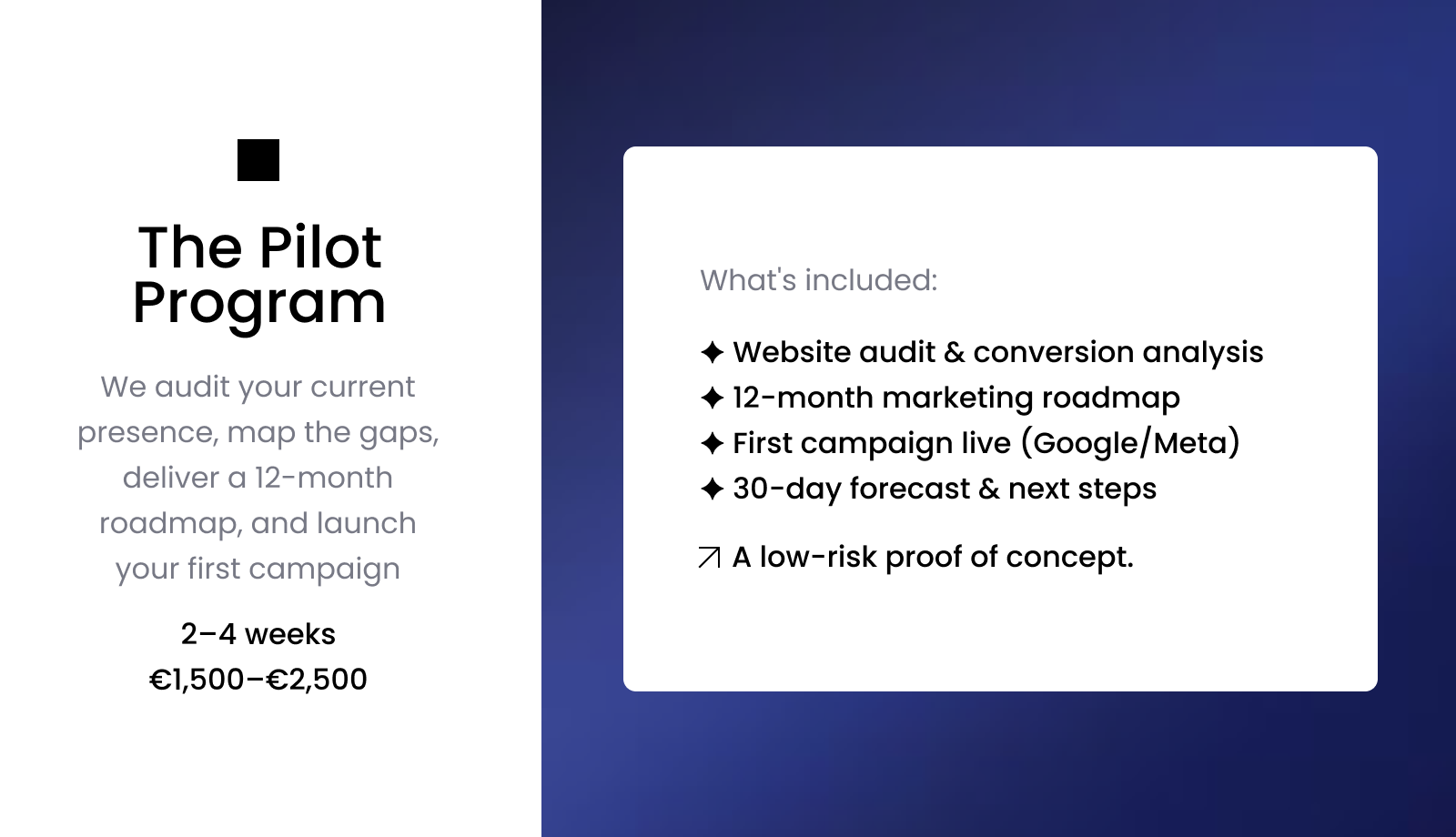
Our Pilot Programme starts with exactly this audit a low-risk way to see what a connected design, development, and marketing system would do for your conversion rate before committing to anything long-term.
Frequently Asked Questions
Why do hospitality websites have low conversion rates?
Most hospitality websites were designed to communicate the brand experience rather than to facilitate a booking decision. The result is a site that impresses visitors but does not convert them because the information a guest needs to decide (location, availability, price range, what to expect) is buried beneath atmospheric design, and the booking action requires too much effort to find. The four most common conversion killers are slow mobile load times, no visible booking CTA above the fold, no social proof near the booking button, and redirecting guests to an OTA rather than enabling direct booking on the site.
What is a good conversion rate for a hospitality website?
Hospitality website conversion rates vary by venue type, traffic source, and booking complexity. For restaurants, a direct booking conversion rate of 3–8% from organic search traffic is a reasonable benchmark. For hotels, direct booking conversion from website visitors typically ranges from 1–4%. The more meaningful metric is the improvement gap most hospitality websites are converting at half their potential due to addressable friction points. A targeted conversion optimisation programme typically improves direct booking rates by 20–40% within 60–90 days on sites with sufficient traffic volume.
Should a hospitality website link to OTAs or enable direct booking?
Primary booking actions on a hospitality website should always enable direct booking using an embedded widget from your booking system rather than redirecting to an OTA. OTA links generate commission costs (typically 15–25% per booking), remove the guest from your brand environment, surface competitor recommendations, and prevent you from capturing guest data in your CRM. OTA links have a place in your ecosystem they are important for discoverability, but they should not be the destination of a guest who has already found your website and decided to book.
How do I fix slow mobile page load on my hospitality website?
The three most common causes of slow mobile load on hospitality websites are uncompressed images (often 2–5MB per image on image-heavy homepages), full-screen video headers that load before page content on mobile, and third-party scripts loading synchronously before the visible content renders. The fastest fix: compress all homepage images to under 200KB in WebP format, replace full-screen video with a compressed static image on mobile, and defer non-critical scripts. Run Google PageSpeed Insights before and after each change to measure the impact. Most hospitality sites can move from a failing mobile score to a passing one with image compression and video deferral alone.
What social proof should be placed near the booking button on a hospitality website?
The most effective social proof near a hospitality booking CTA is your Google review score and review count (e.g., "4.8 ★ from 312 reviews"), a single high-impact testimonial from a genuine guest (not a generic quote), and any credible press or award recognition presented as a logo mark rather than a text quote. The social proof element should be within two design elements of the booking button either directly above it, beside it, or in the immediately preceding section. Placing reviews in a dedicated section further down the page means most guests who need social proof to book will never see it.


Explore more insights
.png)

Start your next project today!
